
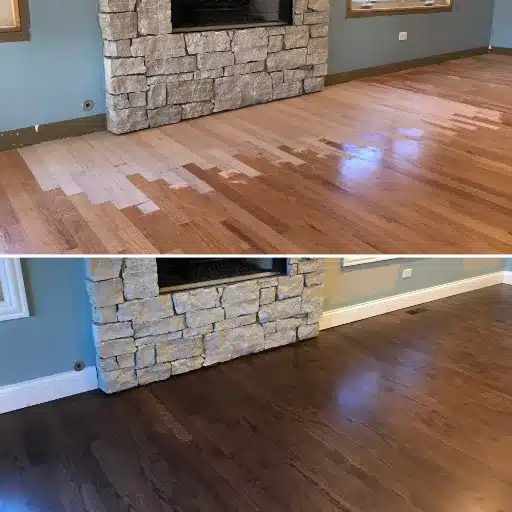
Prefinished vs Unfinished Hardwood Flooring: Pros, Cons and Cost
Prefinished hardwood arrives from the factory already sanded, stained and sealed, so it installs in one to three days with almost no dust. Unfinished hardwood is delivered bare and finished on site, which costs more in labour and days of downtime but gives you a perfectly flush, bevel-free surface and unlimited control over colour.
That is the short answer. The longer answer is that most people ask the prefinished vs unfinished hardwood flooring question expecting a winner, and there is not one. There is a trade, and which side of it you want depends on three things almost nobody mentions in a quote: how long your house is unusable, how many times the floor can be refinished later, and whether you need to match an existing floor.
Most comparison content stops at a pros and cons list. This guide goes further. It covers what each option actually costs installed, what the site-finishing process does to your home while it is happening, why prefinished floors have bevels, and the specific situations where the usual advice flips.
One clarification before we start, because it trips up a lot of buyers. Prefinished versus unfinished is about when the finish is applied. Engineered versus solid is about how the plank is built.
They are separate decisions. If you are still working out the construction question, our engineered vs. solid hardwood comparison covers it.
This article assumes you have settled on hardwood and are choosing a finish method. For a deeper look at the factory-finished side, see our guide to prefinished engineered wood flooring.
Key Takeaways
- Prefinished is UV-cured at the mill. It arrives walk-on-ready with no site sanding, no solvent smell and no cure time in your home.
- Prefinished usually wins on total installed cost. You pay more per square foot for the material and nothing for finishing labour.
- Site-finishing buys two things prefinished cannot: a flush, bevel-free surface and unlimited custom colour.
- Downtime is a real cost. A site finish means 5 to 10 days of work and furniture held back for 24 to 72 hours after the last coat.
- How many times a floor can be refinished is set by its wear layer, not by the finish method. Solid 3/4-inch flooring takes repeated sandings either way.
Last updated: September 2026 · Reading time: 20 minutes
What Is the Difference Between Prefinished and Unfinished Hardwood?
The wood itself is usually identical. Both options start as the same boards, milled from the same species. The difference is entirely in where and when the finish goes on, and that single change cascades into cost, schedule, appearance and long-term maintenance.
Prefinished (Factory-Finished) Hardwood
Prefinished planks are sanded, stained and sealed on a production line, then cured under high-intensity ultraviolet light. The finish hardens in seconds rather than hours because UV curing is a chemical reaction triggered by light, not a slow evaporation of solvent.
The boards are inspected, bundled and shipped ready to install. Nothing is sanded or coated after they arrive. This is why a prefinished install can be a one-day job in a single room and why there is no plastic sheeting taped across your doorways.
Both engineered and solid planks come prefinished. A solid 3/4-inch prefinished oak plank is a totally normal product, and it behaves differently from a thin-wear-layer engineered prefinished plank in ways that matter. We get to that in the durability section.
Unfinished (Site-Finished) Hardwood
Unfinished planks arrive bare. They are installed first, then sanded in place, stained, and sealed with typically three coats of finish plus a final. The whole floor is one continuous surface when the last coat goes down, which is why site-finished floors look seamless.
That continuity is the real product. A site-finished floor has no bevels, no seams between boards, and a finish film that spans the entire room. It also means the finish quality depends on the crew and the conditions in your house on the day, not on a controlled factory line.
The One-Sentence Version
The wood is the same; the finish location is the whole difference. If you want the floor’s chemistry explained rather than its timing, our guide to aluminum oxide floor finish covers what factory coatings are actually made of and why they wear the way they do.
Prefinished vs Unfinished Hardwood Flooring at a Glance
This table is organised by the consequence of each choice rather than as a list of features. The point is not what each option is, but what each option does to your project.
| Decision factor | Prefinished | Unfinished (site-finished) |
|---|---|---|
| Time before you can walk on it | Immediately | 24 to 48 hours after the final coat |
| Install duration | 1 to 3 days | 5 to 10 days including sanding, staining and coating |
| Dust and odour in your home | Minimal; no site sanding | Heavy sanding dust; solvent odour for days |
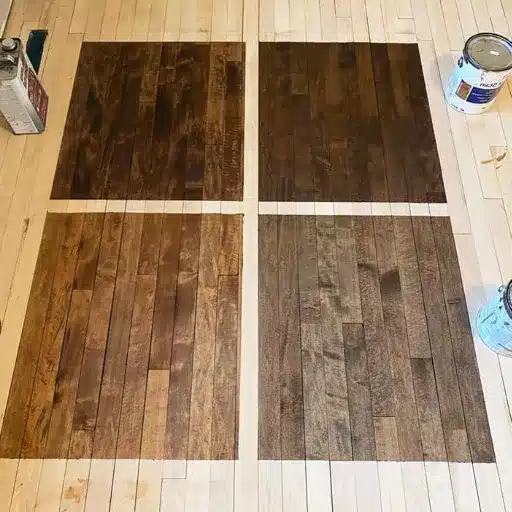
| Custom colour and sheen | Fixed at order; limited to the mill’s palette | Unlimited; mixed and matched on site |
| Edge profile | Micro-bevel at each joint | Perfectly flush, seamless |
| Refinishing capacity | Set by wear layer | Set by plank thickness |
| Matching into an existing floor | Difficult; dye-lot and bevel drift | The only reliable route |
| Schedule risk | Low; one trade, one mobilisation | Higher; two trades and a cure window |
| Best for | Occupied homes, tight schedules, rentals, commercial floors | Historic homes, custom colour, single-room matches |
Choose Prefinished If…
- You are living in the house during the work. No dust containment, no moving out, no smell.
- Your schedule is tight. A site finish adds five to nine days to the job before you can put furniture back.
- You are flooring a rental or commercial space. Downtime is lost revenue, and prefinished floors can be replaced board by board.
- You are installing over a concrete slab. You never have to cure a wet coating over a moisture source.
- You want a fully repeatable colour. Factory batches are consistent; site-mixed stain is a person with a bucket.
Choose Unfinished If…
- You are matching existing floors. This is the strongest argument for site-finishing and it is not close.
- You want a specific custom stain or sheen. Historic colours, a designer’s exact reference, or a hand-mixed tone.
- A flush, bevel-free surface matters to you. Some people genuinely cannot live with shadow lines, and that is fair.
- You are renovating anyway and the rooms are already empty. The disruption argument mostly disappears.
- You want the floor sanded flat as a unit. Site-finishing levels minor subfloor unevenness as a side effect of the process.
The Honest Tie-Breakers
Three situations where the standard advice flips, and where most articles stay silent.
A thin-wear-layer engineered floor should usually not be site-finished. The sanding pass that prepares the surface for a site-applied coating removes material from the wear layer you were relying on. You spend one of a small number of refinishing cycles before the floor has ever been walked on.
A single room added to an existing floor almost always wants a site finish. Two prefinished batches from different production runs rarely blend, and the bevel profile will not match if the original floor is site-finished. You will see the patch forever.
A project where the “cheaper” material price is more than cancelled by soft costs usually wants prefinished. The material maths and the total-project maths are not the same calculation.
Cost: What Prefinished vs Unfinished Hardwood Flooring Costs
The single most repeated claim about this decision is that prefinished costs more. That is true for material and false for the project.
Material Cost Is the Smaller Half of the Story
Unfinished planks typically price lower per square foot than prefinished planks of the same species and grade, because you are buying the wood without a finish. The gap is real but smaller than most buyers expect, and it narrows as you move up in grade.
For a full breakdown of what engineered flooring costs by quality tier, installation method and region, our engineered wood flooring cost guide publishes those figures. This section deliberately covers only the finish-timing delta, because that is the number that changes when you choose prefinished over unfinished.
Finishing Labour Is Where the Comparison Turns
Site finishing adds roughly $2 to $9 per square foot depending on the system. Polyurethane sits at the low end; a custom stain matched to a reference sample, or a hardwax oil system, sits at the top.
That labour buys sanding, stain, three coats and a screening pass. It is also the line item that made prefinished the default choice on most new construction.
A Worked Example at 300 Sq Ft (One Room)
Consider a single 300 sq ft bedroom in a mid-range engineered oak.
| Line item | Prefinished | Site-finished |
|---|---|---|
| Material at $6.00/sq ft vs $5.00/sq ft | $1,800 | $1,500 |
| Installation labour at $4.00/sq ft | $1,200 | $1,200 |
| Finishing labour at $4.50/sq ft | $0 | $1,350 |
| Underlayment and moisture barrier | $150 | $150 |
| Trim and transitions | $120 | $120 |
| Subtotal | $3,270 | $4,320 |
At one room, prefinished is about $1,050 cheaper, or roughly $3.50 per square foot. The material premium is $300. The finishing labour is $1,350. The trade pays for itself by a factor of four.
A Worked Example at 1,000 Sq Ft (Whole House)
Now scale it, because this is where the comparison becomes obvious.
| Line item | Prefinished | Site-finished |
|---|---|---|
| Material at $6.00/sq ft vs $5.00/sq ft | $6,000 | $5,000 |
| Installation labour at $4.00/sq ft | $4,000 | $4,000 |
| Finishing labour at $4.50/sq ft | $0 | $4,500 |
| Underlayment and moisture barrier | $500 | $500 |
| Trim and transitions | $400 | $400 |
| Subfloor prep allowance | $600 | $600 |
| Subtotal | $11,500 | $15,000 |
At 1,000 sq ft the gap widens to $3,500, or $3.50 per square foot. Finishing labour scales linearly with area. The material premium does too, but at $1.00 per square foot against $4.50 per square foot, it never catches up.
Get the numbers for your actual project. Our team quotes hardwood on real room dimensions, subfloor condition and species rather than a per-square-foot rule of thumb. Talk to us about samples and specifications →
The Soft Costs Nobody Quotes
Every estimate above is missing the costs that appear on your bank statement rather than your contractor’s invoice. On a site finish, add:
- Hotel or Airbnb nights if you cannot tolerate the fumes or the dust. Contractors commonly advise three to five nights out for an oil-based finish.
- Pet boarding for the duration, and sometimes longer for the cure window.
- Meals out, because your kitchen may be inside the work zone.
- Furniture storage or a rented pod, since everything comes off the floor.
- A professional deep clean after sanding, because fine dust settles everywhere no matter how good the containment is.
- Days of lost use of the rooms, which is the only line item that applies even if you stay in the house.
On a 1,000 sq ft whole-house job, these commonly add $500 to $2,500. They almost never appear in a comparison table, and they are the reason the “prefinished costs more” claim does not survive contact with a real budget.
Durability: Prefinished vs Unfinished Hardwood Flooring Compared
This is the question people actually ask, and the honest answer needs two parts.
Factory Finish vs. Site-Applied Finish
UV-cured factory coatings are harder and far more consistent than air-cured site-applied polyurethane. That part of the marketing is accurate. A factory finish is applied in a controlled environment, cured in seconds under UV light, and inspected board by board. The National Wood Flooring Association publishes the finish-performance standards that both factory and site coatings get measured against.
This is genuinely where prefinished wins on surface wear. It is not the whole story though, and the part that gets left out is that a harder film is also a more brittle and less repairable one.
But Finish Hardness Is Not Floor Lifespan
A floor has four independent clocks: the finish, the wear layer, the core, and the installation quality. A harder finish on a thin wear layer still runs out first. A perfectly good wear layer over a floor that was installed with the wrong moisture content will cup and gap regardless of how tough the coating is.
So the question “which lasts longer” depends on which clock you mean.
How Many Times Can Each Be Refinished?
Here the answer is not about the finish at all.
Solid 3/4-inch hardwood can be sanded repeatedly under either finish method. It is thick enough that the finish choice is genuinely reversible. This is why solid hardwood is still the most restorable flooring available.
Thin-wear-layer engineered hardwood is capped by its veneer. Below roughly 3/32 of an inch of usable wear layer, sanding is no longer safe. Site-finishing spends one of those limited cycles on day one.
That distinction is the reason this decision matters more on some floors than others. It is also why the advice to “just finish it on site” is often wrong for engineered products. Wood Floor Business is the trade’s working reference if you want the contractor-level version of this argument. For the full step-by-step procedure, our guide to refinishing engineered hardwood floors walks through the sand and recoat options.
The Finish You Can Repair vs. the Finish You Recoat
The genuine durability trade is not hardness, it is repairability, and it is the same trade whether you chose prefinished or not.
A factory aluminum oxide film resists scratches extremely well, but a scratch that does get through reads as a bright white line and blending it is difficult or impossible. An oil-based finish scratches more readily, but a spot repair blends in.
Compare hardwax oil and UV oil systems against aluminum oxide directly in our uv oil vs aluminum oxide flooring comparison if repairability matters more to you than maximum abrasion resistance.
One piece of advice applies either way, and it is the most useful thing in this article. Refresh the clear coat before it wears through to the stained wood. Caught early, that is a coat or two of clear. Caught late, it is a full re-sand and re-stain of the entire floor. If you own a prefinished floor and want to know where that line sits, our guide on can you refinish prefinished engineered hardwood answers it directly.
Bevels, Gaps and the Look of the Floor
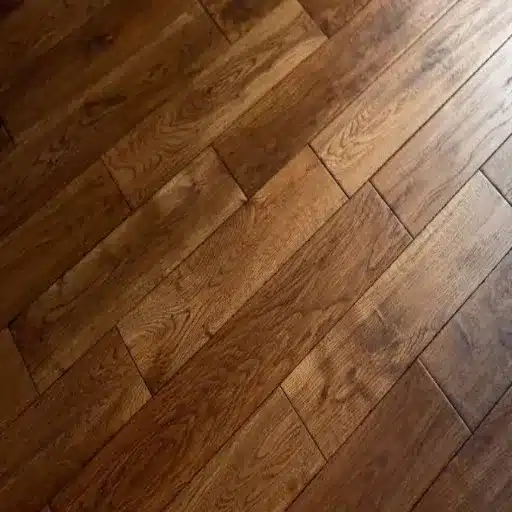
The aesthetic argument against prefinished hardwood is the micro-bevel, and it is the most common reason people choose a site finish despite the cost.
Why Prefinished Floors Have Micro-Bevels
A bevel is a small chamfer machined into the edge of each plank, typically a millimetre or less. It exists for a practical reason: it hides overwood and milling variance between boards.
When a finish is applied at the factory, the planks have not been assembled yet, so nobody knows how much height variation will appear once they are laid on a real subfloor. A slight bevel absorbs that variation invisibly. Without it, every tiny difference in board thickness would show as a lip, and a factory finish cannot be sanded flat after installation to hide it.
What Bevels Cost You in Practice
Be straight about the downsides, because they are real:
- They trap dust. Bevels are channels. A broom pushes debris into them rather than out.
- They read as shadow lines under raking light. Late afternoon sun through a window across a beveled floor is a visible grid.
- They let water into joints. When the floor is mopped, water sits in the bevel. This is a genuine consideration in kitchens and bathrooms.
- They become more visible over time as finish wears at the high points.
None of that makes prefinished a bad floor. It makes it a floor with a specific look.
Bevels vs. True Gaps
These two things get confused constantly, and the confusion causes real disputes.
A bevel is a manufactured edge profile. It is supposed to be there, it is the same width on every plank in the run, and it is evidence the floor was milled to spec.
A gap is a fitting or moisture problem. Real gaps vary in width, show up in clusters, and usually trace to milling tolerance, moisture content at install, subfloor condition, or indoor humidity outside the 35 to 55 percent range.
If the bevels bother you it is a preference. If the boards are separating it is a defect. Our article on prefinished engineered hardwood problems works through which is which and what to document before you call anyone.
If a Flush Surface Is Non-Negotiable
If a continuous, seamless, mirror-flat surface is the entire point of the floor for you, site-finishing is the correct answer and no amount of durability data changes that. It is a legitimate design decision, not an emotional one.
Living Through a Site Finish: Dust, Smell and Downtime
This is the part of the decision that competes with money, and it is the least well documented anywhere. Here is what actually happens.
| Stage | Typical window |
|---|---|
| Install the bare planks | 1 to 2 days |
| Sanding | 1 day, heavy dust |
| Staining | 1 day, dry before coating |
| Three coats of finish | 2 to 3 days |
| Foot traffic | 24 to 48 hours after the final coat |
| Furniture back (polyurethane) | 24 to 48 hours; 72 hours for oil-based |
| Rugs and mats back | 7 to 10 days |
| Full cure | 2 to 4 weeks |
The Real Timeline
Add it up and a site-finished floor is a five to ten day project before furniture returns. A prefinished floor of the same area is one to three days, and the furniture goes back the same day.
Dana found this out the hard way. She booked a three-day window to have 800 square feet of white oak refinished in her occupied home, planning to shift the family into one wing and be done by Friday.
Sanding took two days. The stain needed a full day to dry before coating. The oil-based finish required 72 hours before furniture could return. She spent nine nights on an air mattress in a house that smelled like a paint factory.
The floor came out beautiful. She would still choose site-finishing again for that house, because she was matching original 1930s floors. But she would book two weeks, not three days.
Dust and Odour, Honestly
Every contractor advertises “dustless” sanding. What that usually means is that the sanders are connected to a vacuum and the doorways are sealed with plastic. What it does not mean is that no dust is produced.
It is impossible to sand wood without generating dust, and fine particles travel. Ventilation should start roughly four hours after application. With a low-VOC waterborne finish, odour is largely gone within a day under good conditions. With an oil-based finish, expect days, and indoor air quality in a renovated space can take two to eight weeks to return to baseline.
What to Put in the Contract
Ask for these in writing before work starts:
- The containment method: negative-air machines, sealed doorways, HVAC protection.
- A ventilation plan and how long windows stay open.
- The cure schedule: exactly when foot traffic, furniture and rugs are permitted.
- The finish system by name, so you can check its VOC content and cure times yourself.
- A daily clean-up commitment, not a single clean at the end.
Why This Is the Argument for Prefinished
In an occupied home, the disruption usually decides the question before the maths does. A family with young children, pets, or a home office does not want a week of dust and solvent.
Matching, Replacing and Repairing
Long after installation, this is the factor people wish they had weighed.
Matching New Floors to Existing Ones
Prefinished planks are dyed and finished in production batches, and batches drift. A floor installed two years ago and a box bought today will not match exactly, even in the same SKU. Add a bevel profile difference and a sheen difference, and an invisible splice becomes unlikely.
Site-finishing sidesteps this entirely, because the colour is mixed in the room and matched by eye to what is already there. If matching is a requirement, this is not a preference, it is the only route.
Weaving In a Repair
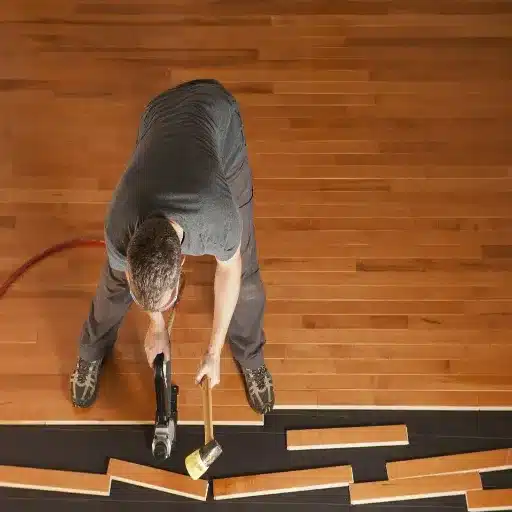
On a prefinished floor, a damaged board is a straightforward swap: cut it out, drop in a replacement, and the bevel hides the join. This is a real advantage for rentals and commercial floors where boards get damaged regularly.
On a site-finished floor, a board replacement means lacing in new wood, then sanding, staining and coating the repair until it disappears. It is more work, and it is why site-finished floors rely on a professional for repairs.
Buy the Spare Box
Whichever you choose, buy 5 to 10 percent extra and store it. Discontinued SKUs are the single most common cause of an unmatched repair, and a sealed box in the garage costs almost nothing at purchase time. For a fuller selection checklist, see our guide to best engineered wood flooring and our aluminum oxide finish guide for what the coating itself will and will not tolerate.
Which Rooms, Which Projects?
The right answer changes by project type more than by preference.
Whole-House Renovation
One mobilisation, one colour, one schedule. Prefinished almost always wins here on total cost and certainty. The exception is a whole-house project in an already-empty house where you want a single seamless surface throughout.
A Single Room Into an Existing Floor
Site finish, nearly always. Matching is the whole problem, and prefinished cannot solve it reliably.
Kitchens and Bathrooms
Neither option is waterproof, and bevels do collect water in a way a flush floor does not. Be clear-eyed about this. Our waterproof engineered wood flooring guide covers which products genuinely tolerate moisture and which are only marketed that way.
Basements and Concrete Slabs
Site-finishing a floor directly over a slab means curing a water-based or solvent-based coating over a moisture source. Prefinished is the safer sequence, with proper vapour management underneath. See our guide to engineered wood flooring for basements for the moisture detail.
Rental Turnover and Commercial Spaces
Downtime is revenue. Prefinished, with a spare box on hand, is the practical answer for any project where the floor has to be back in service quickly.
Homes With Pets and Kids
Scratch visibility matters more than scratch resistance. A matte or low-sheen finish in a mid-tone species hides wear far better than a semi-gloss, and this is true whether the finish went on in a factory or in your living room. A wire-brushed texture disguises footfall and claw marks particularly well.
For a builder’s-eye view of how this plays out across a multi-unit schedule, our engineered wood flooring guide covers construction and specification together.
FAQ
Is prefinished hardwood as good as unfinished?
For surface durability, factory finishes are generally harder and more wear resistant, because they are UV-cured in controlled conditions. For appearance, site-finished floors look seamless while prefinished floors have micro-bevels. Neither is universally better. Site-finished wins on customization and matching, prefinished wins on cost, speed and mess.
Is it cheaper to buy prefinished or unfinished hardwood?
Unfinished planks cost less per square foot for the material. Prefinished almost always costs less once the project is complete, because finishing labour runs $2 to $9 per square foot on top of the material. On a 1,000 sq ft floor that difference is commonly $3,000 or more.
Can you refinish prefinished solid hardwood?
Yes, readily. A solid 3/4-inch prefinished floor can be sanded and refinished multiple times, and the finish it originally carried makes no difference to that capacity. You must remove the entire factory coating before a new finish will bond, which takes an extra pass.
Why do prefinished floors have bevels?
Because the finish is applied before the planks are laid, so there is no opportunity to sand the assembled floor flat. A micro-bevel absorbs small differences in plank thickness and milling tolerance that would otherwise show as a visible lip. It is a manufacturing feature, not a defect.
How long do you have to stay off site-finished floors?
Foot traffic is usually fine after 24 to 48 hours. Furniture should wait 24 to 48 hours over polyurethane and about 72 hours over an oil-based finish. Rugs and mats should stay off for 7 to 10 days, and the finish continues curing for 2 to 4 weeks.
Does site finishing create dust and smell?
Yes, unavoidably. “Dustless” sanding means the machines capture most of the dust and doorways are sealed, not that none escapes. Solvent odour can persist for days with oil-based finishes. Low-VOC waterborne finishes are largely odour-free within about 24 hours with good ventilation.
Can you match prefinished flooring to existing floors?
It is difficult, because production batches drift in colour and sheen, and bevel profiles differ between products. A perfect invisible splice is unlikely. Site-finishing is the reliable way to match an existing floor, because the stain is mixed and adjusted in the room.
Does prefinished flooring increase home value?
Hardwood flooring of either type adds resale value. What buyers respond to is the finished appearance and the absence of wear, not the finish method. A well-maintained prefinished floor and a well-maintained site-finished floor affect a valuation about the same.
Does an unfinished floor need to be acclimated differently?
No. Acclimation is about letting the wood reach the moisture content of its new environment, and both prefinished and unfinished planks need it. For the full step-by-step sequence, including moisture testing and subfloor preparation, see our engineered wood flooring installation guide.
How do you clean a floor finished on site?
Dry removal first, then a damp mop with a pH-neutral cleaner. No wax, no oil soaps and no steam on a film finish. Our wood floor cleaning routine covers the products that are safe on a cured finish.
Conclusion
Prefinished vs unfinished hardwood flooring comes down to one trade. Here it is, compressed.
Prefinished hardwood is faster, cleaner and usually cheaper overall. You pay more per square foot for the material and nothing for finishing labour, and the floor is walk-on-ready the day it goes down. You accept micro-bevels and a fixed palette.
Unfinished hardwood gives you a seamless surface and total colour control. You pay for it in labour, in five to ten days of downtime, in dust and solvent odour, and in the fact that you may need to leave the house.
Three things decide it more often than money. Whether you are living in the house during the work. Whether you need to match an existing floor. And how much wear layer the plank has, because that is what determines how many times either floor can be refinished.
If you are still weighing the finish chemistry, our breakdown of hardwax oil and aluminum oxide finishes is the next read. If you are working out whether your current floor can come back to life rather than be replaced, the veneer finishing page covers how a finish schedule is built and tested before it ships.
Talk to our team about samples, specifications and wholesale pricing. We supply sustainably sourced hardwood and engineered flooring to builders, specifiers and distributors, with the finish documentation and wear-layer data you need to specify with confidence. Request a quote →