
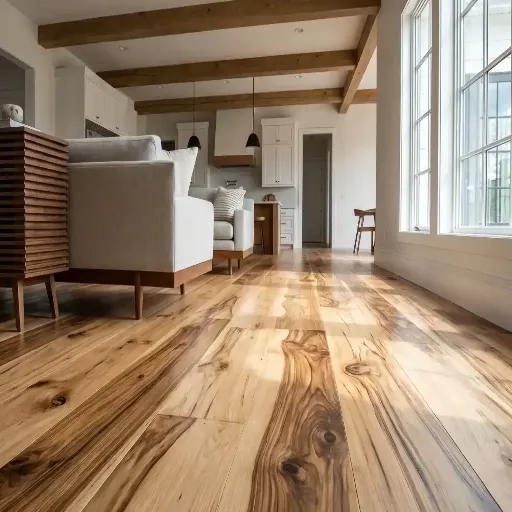
Hickory Flooring Cost: 2026 Price per Square Foot Guide
Hickory flooring costs $4 to $14 per square foot for material and $8 to $23 per square foot installed in 2026. Most homes land between $9 and $16, with engineered hickory at the low end and wide-plank or site-finished solid hickory at the top.
Two honest quotes for the same 500 square foot room can still differ by more than $6,000. Neither supplier is lying. One may carry a 2 mm wear layer, a character grade and a floating install; the other a 4 mm face, select grade, glue-down over a flattened slab and stair work. Same species, same room, different product.
If you have three quotes and can’t see where the money goes, you’re missing a spec sheet, not a secret. This guide breaks pricing down by form, grade, width, wear layer and installation method, then shows the line items most quotes leave out.
If you’re specifying hickory for manufacturing rather than buying a finished floor, send us your veneer or panel specification and we’ll confirm what applies to your order.
Key Takeaways
- Budget $9 to $16 per square foot installed for most hickory floors; wide-plank and site-finished solid work reaches $23.
- Grade, width and wear layer move a quote more than the species label does.
- Hickory lumber prices close to red oak, so the flooring premium comes from yield, color sorting and machining, not scarcity.
- Hidden costs add roughly $2 to $5 per square foot. Budget them before you compare quotes.
- At the thin end, engineered saves money. Wide-plank engineered often costs as much as mid-grade solid.
How Much Does Hickory Flooring Cost in 2026?
Hickory flooring costs about $4 to $14 per square foot for material and $8 to $23 installed. Engineered hickory starts near $8 installed; select-grade solid with wide boards or a site-applied finish reaches $23.
| Form | Material per sq ft | Installed per sq ft | Best for |
|---|---|---|---|
| Engineered, 2–4 mm face | $4–$8 | $8–$14 | Budget projects, slabs, floating installs |
| Engineered, wide or long plank | $8–$14 | $12–$18 | Wide-plank looks without solid-board movement |
| Solid, unfinished | $4–$8 | $9–$16, plus $2–$5 site finishing | Site-finished custom color, nail-down over plywood |
| Solid, prefinished | $6–$14 | $11–$23 | Select grade, 5–7 inch boards, fast occupancy |
| Budget domestic stock | $4–$6 | $7–$12 | Straightforward rooms, standard widths, no prep |
Sources: D&G Flooring (2026), Fixr hardwood cost data (last updated January 2025), ClearCost (April 2026), and our own published hickory tables. For the category-wide picture, see engineered wood flooring cost.
Solid vs Engineered Hickory: Where the Money Goes
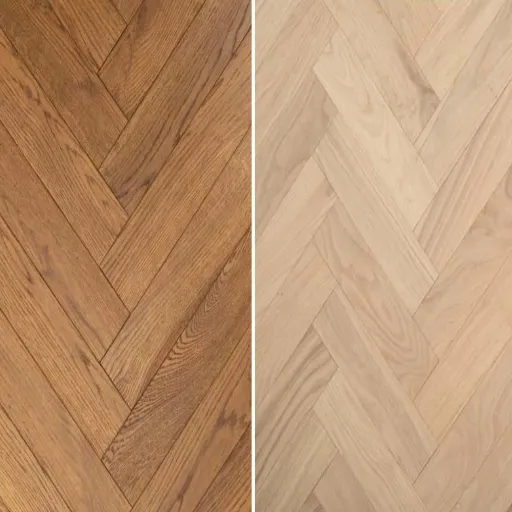
The two forms are priced on different logic: solid by lumber grade and board width, engineered by face thickness and core.
Solid Hickory Prices
Solid hickory material runs $4 to $8 per square foot unfinished and $6 to $14 prefinished at retail. The unfinished end is cheaper because you pay a finisher later. Site sanding and finishing adds $2 to $5 per square foot, which erases most of the saving.
Solid boards are 3/4 inch (about 19 mm) thick, so the full board is the wear layer and supports three to five sandings. The trade-off is movement: the floor follows indoor humidity, and hickory moves more than most species.
Engineered Hickory Prices by Wear Layer
Engineered hickory puts a veneer face on a plywood or HDF core. Face thickness, not species, sets the price and the lifespan.
| Face thickness | Material per sq ft | Refinishings | Notes |
|---|---|---|---|
| 0.6 mm | $3–$5 | None | Rental-grade; can’t be sanded |
| 2 mm | $4–$6 | One light sand | The budget tier most quotes describe |
| 3–4 mm | $5–$8 | One to two | The sensible middle for a long-term home |
| 4–6 mm | $8–$14 | Two to three | Approaches solid performance and price |
A 2 mm face or better is what makes an engineered floor refinishable. The National Wood Flooring Association’s rule is to stop sanding once less than 3/32 inch (2.4 mm) of face remains above the tongue, so a thin face never earns a second pass.
Which Is Better Value?
Engineered wins at the thin end and loses at the thick. A 2 mm floor saves $3 to $6 per square foot against mid-grade solid. A 4–6 mm wide-plank floor costs the same as solid and sometimes more, because wide clear hickory is scarce and pressing adds cost.
For the full construction comparison, see our engineered hickory flooring guide.
What Drives the Price of Hickory Flooring
Five variables explain almost every quote difference, and they matter more than the species name.
Grade and Color Sorting
Hickory has the widest natural color range of any common North American flooring species: one log yields cream sapwood, brown heartwood and dark mineral streaks. Grade decides how much of it survives into your floor.
- Clear boards, minimum 36 inch lengths, look calm and uniform.
- Select boards, minimum 32 inches, show light character.
- #1 Common (Character) boards, minimum 28 inches, show knots and strong contrast. This is the classic calico hickory look.
- #2 Common (Rustic) boards, minimum 24 inches, run heaviest on knots and color swing.
Select typically runs 15% to 25% above natural or character grade. You’re not paying for better wood. You’re paying for the lumber cut away to reach uniformity.
Board Width and Plank Length
Width adds $1 to $3 per square foot for wide or long plank stock, and the gap widens on hickory because clear wide boards are scarce. Boards 3 to 4 inches wide move least, 5 to 7 inches is the popular look, and 8 inches and up should be engineered only. See wide plank engineered wood flooring for the construction changes.
Wear Layer, Core and Face Quality
On engineered stock, face thickness sets price and refinishing capacity. Core choice adds a smaller premium: plywood costs more than HDF and handles moisture better. Ask for face thickness in millimeters, not a layer count.
Finish and Texture
A prefinished aluminum oxide coating is durable and factory-controlled; an oil finish looks softer and needs maintenance. Hand-scraped and wire-brushed textures add labor, since hickory is hard to machine consistently.
Region, Lead Time and Availability
Regional pricing varies 10% to 25% across US markets, and lumber swings 20% to 30% either way (Custom Wood Quote, March 2026). Lead time follows: stock widths ship in days, a custom grade and width in weeks.
Why Hickory Flooring Costs What It Costs
Most cost guides skip this part. Hickory isn’t an expensive tree.
Surfaced hickory lumber runs $5 to $8 per board foot. Red oak runs $4 to $7, white oak $8 to $15, hard maple $5 to $9, and black walnut $10 to $18 (Custom Wood Quote, March 2026). Hickory sits mid-pack, below white oak and well below walnut.
At 3/4 inch, one square foot of flooring consumes about 0.75 board feet before yield loss. So the raw lumber in a square foot of hickory costs roughly $3.75 to $6.00, against a finished price of $4.15 to $7.15.
One caveat: board-foot prices are quoted for surfaced select grades, while flooring runs use lower grades and short lengths. Treat the arithmetic as a species comparison, not a cost build-up.
If the lumber is red-oak money, why does the floor sell 25% to 40% higher? Four costs land after the log:
- Color sorting. A select floor means cutting around sapwood, heartwood and mineral streaks. Good lumber becomes short boards, and that yield loss is what you pay for.
- Machining. Hickory runs 50 to 52 lb/ft³ against red oak’s 43.8. It dulls knives faster, tears out more readily and slows the line.
- Kiln degrade. Hickory’s shrinkage is high, roughly 7% radial and 10.5% to 11.5% tangential. Drying losses run above oak’s.
- Scarce wide clear stock. Long, wide, clean hickory boards are rare enough that the width premium is steeper than for oak.
Illustrative scenario: A mill prices a select-grade hickory run at red-oak log cost, then watches yield fall because a third of the boards carry too much color contrast to use. The loss never appears on a lumber invoice. It surfaces in the price per square foot later.
Hickory vs Oak, Maple and Walnut: Cost Comparison
Hickory isn’t the most expensive common species, which surprises buyers who assume hardness sets price.
| Species | Janka | Material per sq ft | Installed per sq ft | Surfaced lumber per bf |
|---|---|---|---|---|
| Red oak | 1,220 | $3–$5.75 | $8–$13 engineered, $9–$20 solid | $4–$7 |
| White oak | 1,360 | $3.75–$7 | $8–$16 engineered, $9–$20 solid | $8–$15 |
| Hickory | 1,820–2,140 | $4.15–$7.15 | $8–$14 engineered, $9–$23 solid | $5–$8 |
| Hard maple | 1,450 | $6.25–$10 | Material only in public tables | $5–$9 |
| Black walnut | 1,010 | $8.25–$10.50 | $10–$20 solid | $10–$18 |
Sources: Fixr for material, our published installed ranges, Custom Wood Quote for lumber, for Janka.
Hickory material sits close to white oak and below hard maple and walnut. Installed, it runs roughly 25% to 40% above red oak at material level but only 0% to 15% above installed, because labor is similar and dominates the invoice.
For the head-to-head, see hickory vs oak flooring. The sibling cost guides cover maple flooring cost and walnut flooring cost.
Hickory Flooring Cost: Installation and the Labor Premium
Installation labor runs $3 to $6 per square foot for a standard floor, or $60 to $80 per hour for a carpenter. Stairs and wide plank push toward the top, and wide plank can reach $8.
| Method | Labor per sq ft | Notes |
|---|---|---|
| Floating | $2–$4 | Fastest; needs a level subfloor and underlayment |
| Glue-down | $3–$6 | Standard for concrete and radiant heat |
| Nail-down | $3–$6 | Solid over plywood; wide plank to $8 |
| Site finishing | Add $2–$5 | Unfinished stock only; sanding, staining, coating |
Hickory carries an unadvertised premium. It’s hard to cut, needs pre-drilling and sands slowly. Some installers add a line for it; most fold it into the rate. Ask whether the quote assumes oak or hickory.
For method-by-method detail, see engineered wood flooring installation.
The Hidden Costs Most Hickory Guides Leave Out
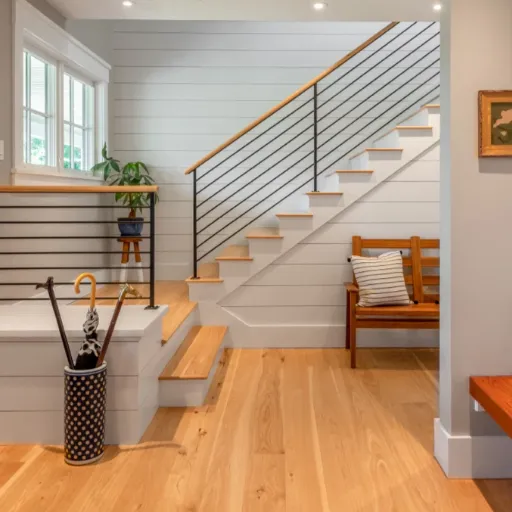
A headline price per square foot is rarely the invoice.
- Old floor removal: $1 to $3 per square foot, plus disposal.
- Underlayment: $0.25 to $0.75 per square foot.
- Moisture barrier and adhesive: roughly $1.00 to $1.50 per square foot on a glue-down.
- Subfloor flattening: quoted per job; a wavy slab can add more than the flooring.
- Trim, transitions and thresholds: per linear foot, and easy to overlook in open-plan rooms.
- Stair nosings: $145 to $210 per step.
- Waste: 5% to 10% for straight installs, 15% on diagonal or herringbone.
- Attic stock: 5% held back for future repairs on a variegated floor.
- Delivery, tax, permits and furniture moving: varies by state and job size.
Budget $2 to $5 per square foot above the headline number. A quote that includes them looks higher and may still be cheaper.
A Real Hickory Flooring Budget: 500 Sq Ft
Here’s what those ranges look like in one room, with 10% waste.
| Line item | Low | Mid | High |
|---|---|---|---|
| Material (550 sq ft with waste) | $2,475 at $4.50 | $3,575 at $6.50 | $6,050 at $11.00 |
| Installation | $1,500 at $3.00 | $2,250 at $4.50 | $3,000 at $6.00 |
| Underlayment or adhesive | $250 | $600 | Included |
| Trim and transitions | $350 | $450 | $900 with stairs |
| Removal and disposal | $750 | $750 | $750 |
| Subfloor preparation | Not needed | $500 | $700 |
| Total | $5,325 | $8,125 | $11,400 |
Low is character-grade engineered at 2 mm, floated, with removal but no subfloor work. Mid is 3–4 mm engineered, glued down over a skim-coated slab. High is select-grade solid, 5 to 7 inches wide, nailed down, with stairs.
Published 500 square foot figures run $3,500 to $8,000 (D&G Flooring), which covers the lean end of this table.
Is Hickory Flooring Worth the Premium?
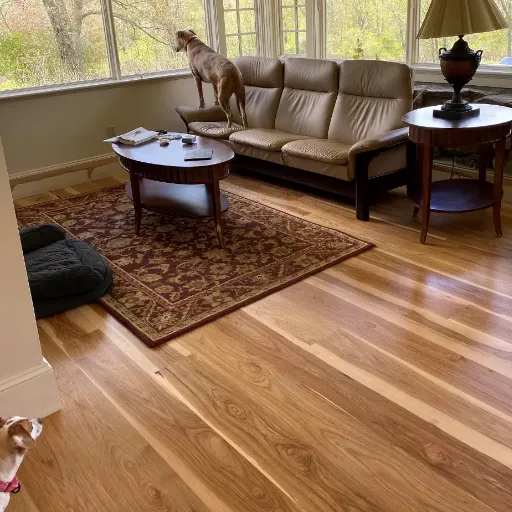
Hickory’s case rests on dent resistance, not low cost. At Janka 1,820 to 2,140 it outlasts oak and maple against claws, toys and dropped objects.
That hardness has a limit. Janka measures dent resistance, not scratch resistance: the finish takes the scratches, and a hard floor is unforgiving underfoot. Lifetime math matters more than the sticker:
- Refinishing engineered hardwood costs $3 to $6 per square foot, or $1,500 to $3,000 per cycle on 500 square feet. Stairs add $40 to $80 per tread.
- Solid hickory supports three to five sandings. Engineered supports one to three, depending on face thickness.
- A 2 mm engineered floor may never be sanded at all. That’s the real price of the cheapest quote.
- Color variation makes board replacement hard, which is why attic stock matters.
Divide a $9 floor over 25 years: about $0.36 per square foot per year. A single $2,000 refinish at year 12 adds roughly $0.16. Compare that with a cheaper floor you’d replace in 15 years.
For the full decision, see hickory flooring pros and cons.
How to Save on Hickory Flooring Without Regret
- Choose character or #1 Common grade if you like the calico look. It’s the cheapest way to buy hickory and the most honest use of the species.
- Stay at 5 inches rather than 7 or 8. The width premium is real and the movement is smaller.
- Take a 3–4 mm face over a 2 mm face. The saving is a few dollars a foot; the loss is every future refinish.
- Buy prefinished unless you specifically want a site-applied color. Site finishing adds $2 to $5 per square foot.
- Float the floor where the subfloor allows it. Glue-down and nail-down both cost more in labor.
- Buy from a mill rather than a retailer, and compare like-for-like specifications.
- Get three itemized quotes listing grade, width, face thickness, waste and removal separately.
Illustrative scenario: A homeowner in Ohio chose character grade over select, saved about $1,900 on 700 square feet and kept the look she wanted. The saving came from the grade she wanted, not from a worse floor. The one saving to refuse is the moisture barrier: skip it over a slab and hickory’s movement will find the gap.
FAQ About Hickory Flooring Cost
How much does hickory flooring cost per square foot?
Material runs $4 to $14 per square foot and installed cost $8 to $23. Most homes land between $9 and $16 installed.
Is hickory flooring more expensive than oak?
Yes at material level, by roughly 25% to 40% against red oak, and it sits close to white oak. Installed, the gap narrows to 0% to 15% because labor is similar and dominates the invoice.
Why is hickory flooring so expensive?
Not because the tree is rare. Surfaced hickory lumber costs $5 to $8 per board foot, close to red oak. The premium comes from color sorting, lower yield on select grades, faster tool wear and higher kiln losses on a dense, movement-prone wood.
Is engineered hickory cheaper than solid hickory?
Usually at the entry level, not at the top. Standard engineered material runs $4 to $8 per square foot against $4 to $8 unfinished solid, but wide-plank engineered reaches $8 to $14 and can cost more than mid-grade solid once installed.
Do installers charge more for hickory?
Often, though few say so on the quote. Hickory dulls blades, needs pre-drilling and sands slowly. Ask whether the labor rate assumes oak or hickory before comparing two quotes.
How much does hickory flooring cost for 1,000 square feet?
Roughly $9,000 to $14,000 installed for standard engineered and $9,000 to $23,000 for solid. Our published 1,000 square foot example of 3–4 mm engineered over concrete came to $7,500 to $13,000 before hidden costs.
Is hickory flooring worth the money?
It’s worth it if you need dent resistance and want bold character. It’s hard to justify for a calm, uniform floor or the lowest installed price, where oak or maple cost less and match more easily later.
Conclusion
Hickory flooring cost comes down to five numbers: grade, width, face thickness, installation method and site condition. The species name explains less than any of them.
Expect $9 to $16 per square foot installed for most homes, $5,300 to $11,400 for a 500 square foot room, and $2 to $5 per square foot in hidden costs on top of the headline quote. Hickory material sits below hard maple and walnut, close to white oak, and 25% to 40% above red oak.
The premium is real, but it’s a yield premium, not a rarity premium. Buy the grade you want, take a face thick enough to sand, and hold back attic stock.
Vital Wood Global supplies hickory veneer and veneer-faced panels to flooring, furniture and millwork manufacturers. We don’t sell or install finished flooring, so treat these figures as planning ranges, not a quote. If you’re producing engineered hickory, send your specification with face thickness, core, grade and volume, and we’ll confirm availability. For the wider picture, see our hickory flooring hub or the engineered wood flooring guide.