

Sustainable Hickory Flooring: FSC, Lacey Act and Legal Sourcing
Is hickory flooring sustainable? Check CITES status, Lacey Act declarations, FSC and PEFC labels, and the EUDR deadline before you write the flooring spec.
Sustainable hickory flooring is a documentation claim before it is a species claim. American hickory is not CITES-listed. Native U.S. species are assessed as Least Concern, and U.S. hickory growth exceeds harvest nationally. None of that tells you whether a specific shipment was harvested legally. It also doesn’t prove the forest was well managed, or that any certificate covers the product you bought.
That distinction matters more every year. Buyers now face a Lacey Act declaration on entry to the United States. They also face a European due diligence deadline in December 2026, and a market full of logos that look alike. Four documents resolve most of the question. First, the import declaration and its supporting due care file. Second, a forest certificate whose scope includes the product. Third, a destination-market due diligence record. Fourth, core emission data for engineered construction.
This guide explains each document and the dates that apply. It’s written for specifiers, importers, distributors, and manufacturers who have to defend the choice after the floor is installed.
Key Takeaways
- Hickory (Carya spp.) is not CITES-listed, and native U.S. species are assessed as Least Concern. Commercial supply is not the sustainability problem; legal origin and document scope are.
- U.S. hickory growing stock is 742.3 million m³. Growth of 14.6 million m³ a year exceeds harvest of 5.9 million m³, with Louisiana the one significant producing state where it does not.
- Lacey Act declarations require the scientific name and harvest location for every plant component, including the wear layer and the core. Paper filing ended on 1 January 2026.
- FSC Mix and PEFC Controlled Sources are weaker claims than the logos suggest. Ask for the certificate code and the percentage, not the badge.
- The EUDR applies to assembled flooring panels under CN 4418 from 30 December 2026 for large and medium operators. Harvest geolocation is the hardest part to produce.
If you are assembling a specification now, the wood panel compliance document checklist lists the files to request before a quote is finalized.
Is Hickory Flooring Sustainable? The Short Answer
When buyers ask “is hickory sustainable,” the honest answer is that the species isn’t the variable. Hickory can be a sustainable flooring choice when three conditions hold. The wood was harvested legally. The forest it came from is managed under a system you can check. The floor stays in service long enough to justify the wood used.
The species supports the third condition well. Hickory is dense and hard, with a Janka rating of 2,140 lbf for pignut and 1,880 lbf for shagbark. A floor that survives 40 years and two sandings uses less wood per decade than a softer floor replaced twice.
The species doesn’t prove the first two conditions. Those depend on where the log grew, who owned the forest, and what the supplier can document. A sustainable hickory flooring specification therefore starts with a supplier file, not a species name.
Hickory is a genus, not a species. Carya includes shagbark, pignut, mockernut, and pecan, and the trade often sells hickory and pecan mixed because they’re hard to separate as logs. That’s normal, but a purchase order that says only “hickory” is incomplete for a customs declaration.
At the national level, supply is not the constraint. The American Hardwood Export Council reports U.S. hickory growing stock of 742.3 million m³, about 4.7% of total U.S. hardwood growing stock. Growth runs at 14.6 million m³ a year against harvest of 5.9 million m³, a net increase of 8.6 million m³. Growth exceeds harvest in every significant producing state except Louisiana.
Those are national figures. They describe the resource, not your shipment. A supplier can source from a state with strong growth and still fail to produce a harvest record for a specific lot.
What the species does and does not prove
Durability is a performance fact. Sustainability is a provenance fact. Hickory’s density explains its dent resistance and its movement, not its origin.
Shagbark hickory shrinks about 10.5% tangentially from green to oven-dry, and pignut about 11.5%. That’s more movement than red oak, which is why engineered construction is common for wide hickory planks. None of those numbers says anything about legality. A dense board from an unpermitted harvest is still an illegal board.
Consider a specifier in Rotterdam comparing two offers. Both say “FSC-certified hickory, 4 mm wear layer.” One attaches a certificate code, the holder name, and the product scope. The other attaches a logo and a sustainability paragraph. At the same price, they are not the same offer.
Is Hickory Endangered or CITES-Listed?
No commercial hickory species appears in the CITES Appendices. The Wood Database records pignut and shagbark hickory as absent from both CITES and the IUCN Red List of Threatened Species.
The IUCN picture needs one qualification. Native U.S. hickories are assessed as Least Concern, including the species used for flooring. Two groups sit outside that statement.
Mexican hickory (Carya palmeri) is assessed as Vulnerable, and some Asian species, including Carya sinensis, are Endangered. Neither is a commercial North American flooring species, but a supplier using the bare trade name “hickory” from an Asian origin should be asked for the botanical name.
This is where trade names cause trouble. “Hickory” is used for several species and for pecan, so hickory vs pecan flooring comes down to the botanical name.
The AHEC page notes that hickory and pecan are “virtually indistinguishable” as logs and are often sold mixed. Mixed supply is acceptable when both components are legal. It becomes a problem when the declaration lists one species for a bundle that contains two.
If a buyer asks whether hickory is endangered, the accurate answer is species-specific. The commercial North American supply is not, but a blanket “no” ignores the Mexican and Asian assessments.
What the Lacey Act Requires for Sustainable Hickory Flooring
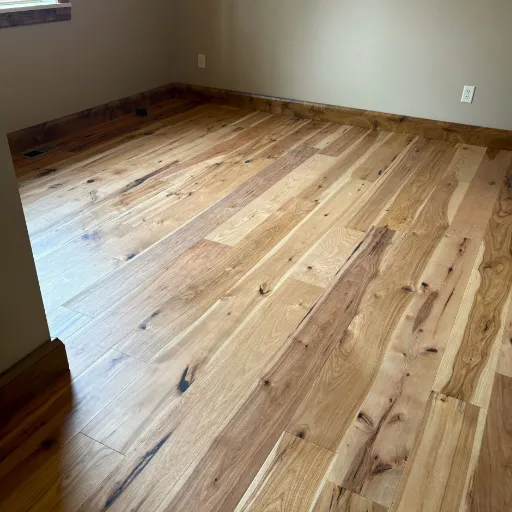
The Lacey Act prohibits the import, export, transport, sale, receipt, or purchase of plants taken in violation of U.S. law or relevant foreign law. For a flooring importer, the visible requirement is a declaration. The enforceable requirement is a file that supports it.
The declaration is PPQ Form 505 or 505B. It is filed by the importer of record or their agent, primarily through CBP’s ACE system; APHIS also operates the LAWGS portal. APHIS stopped accepting paper submissions on 1 January 2026. A supplier who still offers a paper form is describing a process that no longer exists.
For each plant component, the filer must provide the scientific name and where the plant was harvested. That last phrase is the one that catches engineered flooring.
The declaration, component by component
An engineered hickory plank is not one plant product. It typically contains a hickory wear layer, a plywood or HDF core, and sometimes a back veneer. Each component has its own species and origin, even when the finished board is sold under one species name.
A declaration that says “hickory, China” for the whole board is incomplete if the core is poplar from a different province or eucalyptus from another country. The importer of record carries the liability, not the factory.
Phase VII, which began on 1 December 2024, added furniture, sporting goods, housewares, tools, boats and vehicles, and cork to the declaration system. Wood flooring has been inside the system for longer. Confirm the specific HTS line in APHIS’s implementation schedule rather than relying on a supplier’s summary, because the schedule is updated by Federal Register notice.
What due care looks like in a supplier file
Lacey liability turns on due care, the reasonable steps an importer takes to verify species and origin. The Act doesn’t provide a checklist that automatically satisfies it. APHIS tells importers to know the supply chain for each piece of plant material and to ask suppliers where the wood was harvested.
A defensible file usually contains:
- The botanical name for each component, not only the trade name.
- Harvest country and, where available, state or province.
- The supplier or mill that produced each component.
- Invoices and packing lists that match the declaration.
- A forest certificate code and scope, if a certificate is claimed.
- Harvest records, permits, or a programme statement where the origin is high risk.
A Texas importer books a container of engineered hickory. The broker asks for the scientific name and harvest location of each component. The invoice says “hickory engineered flooring, China.” The shipment waits while the factory reconstructs where the veneer and core came from. That delay is what happens when nobody built the due care file.
FSC and PEFC: What the Label Actually Certifies
Forest certificates are the most misunderstood documents in the category. A logo on a website says almost nothing. A certificate code, a holder name, a status, and a product scope say something specific.
The Forest Stewardship Council (FSC) uses three product labels.
| FSC label | What it means | What it does not tell you |
|---|---|---|
| FSC 100% | All forest material comes from FSC-certified forests | Carbon, transport, or the non-wood components |
| FSC Mix | A mix of FSC-certified, recycled, and/or FSC Controlled Wood | The certified percentage, which is not on the label |
| FSC Recycled | The product is made from 100% recycled material | Whether the rest of the supplier’s range is certified |
FSC Mix exists because wear layers and cores often come from different supply streams. Controlled Wood is screened to avoid unacceptable sources, but it isn’t certified forest material. A buyer who needs certified content should ask for the percentage and the transaction certificate, not the label image.
PEFC works differently in one important respect. A “X% PEFC certified” claim must state a percentage, and on-product labels generally require at least 70% certified content.
“PEFC Controlled Sources” is a separate claim. It describes material cleared through a due diligence system as negligible risk. It’s explicitly not certified material, and it never carries a percentage.
The verification step is the same for both schemes. Take the certificate code from the invoice or pack list and search it in the scheme’s public certificate database. Check the holder, the status, the scope, and whether the product or species is inside that scope. A company certificate doesn’t automatically cover a new product line, and a chain-of-custody system is only as good as the transaction records behind it.
Vital Wood Global offers FSC-certified options across its veneer and panel range. Availability depends on species and order, so confirm the certificate scope for your specification. The FSC-certified wood veneer panels page explains how the claim is structured, and sustainable veneer covers the sourcing side.
EUDR: The 2026 Deadline and the Origin Data Buyers Will Need
The European Union Deforestation Regulation (EUDR) applies to wood products placed on the EU market. Assembled flooring panels under CN 4418 fall within Annex I. The regulation is not a certification scheme. It’s a due diligence obligation with a statement attached.
The dates that matter now:
| Operator | Application date |
|---|---|
| Large and medium operators | 30 December 2026 |
| Micro and small operators already covered by the EU Timber Regulation | 30 December 2026 |
| Remaining micro and small operators | 30 June 2027 |
| Products added later by delegated act | 30 December 2027 |
The substantive test is that the product is deforestation-free and legally produced. The cut-off is 31 December 2020: the land must not have been deforested after that date.
Operators placing covered products on the market for the first time must file a due diligence statement through the EUDR information system on TRACES.
The hard part is geolocation. The file needs the location of the plots where the wood was harvested, not only the country.
A mill that buys logs on the open market may not know the plot. That’s why the American Hardwood Assured (AHA) programme exists.
What American Hardwood Assured provides
AHA is run by the American Hardwood Export Council. The programme is documented at American Hardwood Assured. It is a due diligence programme, not a certification, and it should be described that way in a submittal.
The programme assesses deforestation risk at county level. It uses the USDA Cropland Data Layer, Landsat imagery, and Copernicus Sentinel-2 imagery at a resolution of up to 10 m. It assesses legality risk at state level through a jurisdictional risk assessment that covers the chain from harvest to export.
Its due diligence portal went live on 15 September 2025. Harvest site detection was scheduled for 16 October 2026, and proof of provenance procedures are planned by 30 September 2027.
For a buyer, the useful output is a statement that ties a shipment to a county-level risk assessment, plus optional harvest-site location data. That is a due diligence input. It doesn’t replace the operator’s own statement, and it doesn’t make the product certified.
An EU distributor asks a U.S. mill for plot coordinates. The mill can provide county risk data and, where the programme has been applied, harvest-site coordinates. A trader who bought through three intermediaries may not be able to reconstruct the same chain. The difference is usually visible before the first order, if the buyer asks.
Engineered vs Solid Hickory: Which Specification Is More Sustainable?
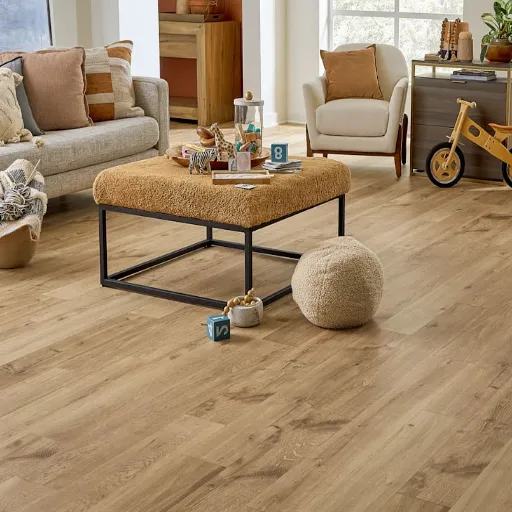
Neither construction wins by default. The sustainability case depends on wear layer, core, finish, and how long the floor stays in place.
| Criterion | Solid hickory | Engineered hickory |
|---|---|---|
| Hickory used per m² | Higher | Lower, because the wear layer is thin |
| Dimensional movement | High; about 10.5% tangential shrinkage for shagbark | Restrained by the cross-ply core |
| Adhesive and core content | Minimal adhesive; no core | Core and adhesive add a separate supply chain |
| Refinishing capacity | Several sands over a thick board | Limited by wear layer thickness |
| Indoor emission file | Finish and any adhesive | Core plus adhesive plus finish |
| Transport weight | Higher | Lower |
The common assumption is that engineered flooring is greener because it uses less scarce wood. That’s only true if the floor lasts.
A 2 mm wear layer that can’t be sanded may be replaced while a solid floor would still be serviceable. The better specification is the one whose wear layer supports the maintenance cycle the project can actually fund.
The common assumption in the other direction is that solid wood is automatically cleaner. That ignores finish chemistry and, for engineered products, the core.
For engineered hickory flooring, the core is the document you need. TSCA Title VI limits formaldehyde emissions from hardwood plywood, MDF, and particleboard. Its limits are set at the same levels as CARB ATCM Phase II.
Products must be labeled TSCA Title VI compliant, and the label must be supported by third-party certification. Ask for the certification and the label, not a general “low VOC” statement. The engineered hickory vs solid hickory comparison covers the performance trade-offs in more detail.
How to Verify a Sustainable Hickory Flooring Supplier
A sustainability claim is only as good as the file behind it. Use the same eight requests for every quote, and compare the answers side by side.
| # | Request | What a good answer looks like |
|---|---|---|
| 1 | Botanical name and harvest country for each component | Species-level names for wear layer, core, and back; state or province where available |
| 2 | Lacey Act declaration and supporting records | PPQ 505 data that matches the invoice; component-level species and origin |
| 3 | Forest certificate code and scope | A code that resolves in the public database, with the product inside the scope |
| 4 | Certified percentage for FSC Mix or PEFC claims | A stated percentage and a transaction certificate, not a logo |
| 5 | EUDR due diligence records, if the destination is the EU | Harvest geolocation or a documented route to it; AHA statement where applicable |
| 6 | Core emission documentation for engineered products | TSCA Title VI certification and label for the core |
| 7 | Wear layer thickness and refinishing plan | A thickness that supports the recoat and sand cycle the project needs |
| 8 | Take-back, spare stock, and replacement policy | Written terms, not a verbal promise |
Three questions expose a weak file faster than the rest.
| Question | A weak answer | A strong answer |
|---|---|---|
| What is the scientific name of the core? | “Plywood” | A species name and harvest country for the core |
| Which certificate covers this product, and what is its scope? | A company certificate for a different product line | A code that resolves, with the product inside the scope |
| Where was the wood harvested? | A country | State, county, or plot coordinates |
A supplier who can answer all three has a traceable file. One who can’t is selling a species name. Commercial work adds submittals, warranties, and lot control, which the commercial hickory flooring guide covers.
Vital Wood Global supplies veneer, veneer panels, plywood, and edge banding, so the compliance file often starts one step upstream of the finished floor. For manufacturers building engineered flooring, the hickory lamella and the plywood core carry separate declarations. The sustainable wood veneer sourcing guide covers supplier qualification, and the wood veneer supply chain article explains how origin records move through a mill.
Building a specification? Send the panel schedule and destination market. We will confirm which species, cut, backing, and core options apply, and which certification documents can be issued with the order.
FAQ About Sustainable Hickory Flooring
Is hickory flooring sustainable?
Hickory flooring can be sustainable when the wood is legally harvested, the forest is managed under a checkable system, and the floor stays in service long enough to justify the material. Hickory is not CITES-listed, and native U.S. species are assessed as Least Concern. Those facts describe the resource, not a specific shipment.
Is hickory endangered?
No commercial North American hickory species is endangered. Native U.S. hickories are assessed as Least Concern. Mexican hickory (Carya palmeri) is assessed as Vulnerable and some Asian species are Endangered, but they are not the commercial flooring supply. Ask for the botanical name when the origin is not North America.
Is hickory flooring eco friendly?
It can be, but “eco friendly” is not a specification. Judge it on four documents: legal origin, a forest certificate whose scope covers the product, core emission data for engineered construction, and a wear layer thick enough to refinish. A floor that lasts 40 years avoids the impact of replacement.
Does hickory flooring need FSC certification?
FSC certification is not legally required in the United States. It is a procurement requirement on many projects and a due care input under the Lacey Act. If a project specifies FSC, ask for the certificate code, the holder, and the product scope, and confirm the claim on the invoice.
What is a Lacey Act declaration for hickory flooring?
It is PPQ Form 505 or 505B, filed through CBP’s ACE system or APHIS’s LAWGS portal. It records the scientific name and harvest location for each plant component in the product. Paper filing ended on 1 January 2026, and the importer of record carries the liability for accuracy.
Does EUDR apply to hickory flooring?
Yes, if the product is placed on the EU market. Assembled flooring panels under CN 4418 are in Annex I. Large and medium operators must comply from 30 December 2026, and remaining micro and small operators from 30 June 2027. The file needs harvest geolocation and a due diligence statement through TRACES.
Conclusion
Sustainable hickory flooring is a file, not a slogan. The species is a strong starting point: hard, abundant at the national level, not CITES-listed, and assessed as Least Concern across its native U.S. range. It isn’t the answer to the question a buyer is actually asking.
The answer comes from four documents. A Lacey Act declaration that names the species and origin of every component. A forest certificate whose code resolves and whose scope covers the product. An EUDR due diligence record with harvest geolocation, if the destination requires it. Core emission certification for engineered construction.
Ask for all four before you compare price. A supplier who can produce them is selling a specification. A supplier who can’t is selling a species name and hoping the paperwork never gets tested.
If you need the material side of that specification, send your requirements with the species, cut, backing, core, thickness, and destination. We will confirm what can be supplied and which documents can be issued with it. For the full construction picture, start with the engineered hickory flooring guide.