
Walnut Flooring Cost: 2026 Price per Square Foot Guide
Walnut flooring cost runs from about $9 to $32 per square foot installed in 2026, with most homes landing between $12 and $19. Materials alone range from $6 to $22. Budget engineered boards anchor the low end, mid-grade solid and engineered boards sit in the middle, and wide plank or custom finishes push toward the ceiling.
That spread is the most useful number here. The gap between the cheapest and most expensive quote is rarely a pricing trick; it is usually two genuinely different products. Three honest quotes for “walnut flooring” can differ by $11,000 because one was a thin-wear-layer board with heavy sapwood and the other a wide, clear-grade plank.
This guide covers what moves the number and which line items retailers leave off the quote. Every figure is a national U.S. range, not a quote, and lumber markets alone can swing 20 to 30 percent.
Key Takeaways
- Most homes pay $12 to $19 per square foot installed for walnut, with budget engineered at $9 and premium wide plank reaching $32.
- Engineered walnut is not automatically cheaper. At a 4 to 6 millimeter wear layer it costs as much as solid, and sometimes more.
- Grade and wear layer move a quote more than the species label does. Ask for both on the spec sheet.
- Hidden costs add roughly $2 to $5 per square foot. Budget them before you compare quotes.
- Walnut is under 5 percent of the U.S. hardwood resource. The premium is supply, not marketing.
How Much Does Walnut Flooring Cost in 2026?
Walnut flooring costs $9 to $32 per square foot installed, with most residential projects falling between $12 and $19. Material accounts for roughly half of that total; installation and prep make up the rest.
| Product form | Material per sq ft | Installed per sq ft | Best for |
|---|---|---|---|
| Solid walnut, unfinished | $6 to $15 | $10 to $20 | Site-finished custom color, long-term homes |
| Solid walnut, prefinished | $8 to $14 | $11 to $20 | Factory finish and warranty |
| Engineered, 2 mm wear layer | $6 to $9 | $9 to $14 | Budget rooms, slabs, rentals |
| Engineered, 3 to 4 mm wear layer | $8 to $12 | $12 to $19 | Most homes, one to three refinishes later |
| Engineered, 4 to 6 mm wear layer | $11 to $18 | $16 to $25 | Premium look, over radiant heat |
| Wide plank or custom finish | $14 to $22 | $20 to $32 | High-end open-plan spaces |
Two things stand out. The engineered range overlaps solid almost entirely at the top, and the cheapest engineered option costs less than half the priciest solid one. Both sell as walnut.
Want to see how these tiers look in a real room? Our guide to engineered walnut flooring walks through construction, grades, and finish options side by side. For the wider category, our engineered wood flooring guide covers how construction affects price across species.
Solid vs Engineered Walnut: What You Actually Pay For
The solid-versus-engineered decision is where most of the price spread lives.
Solid Walnut Flooring Cost by Grade
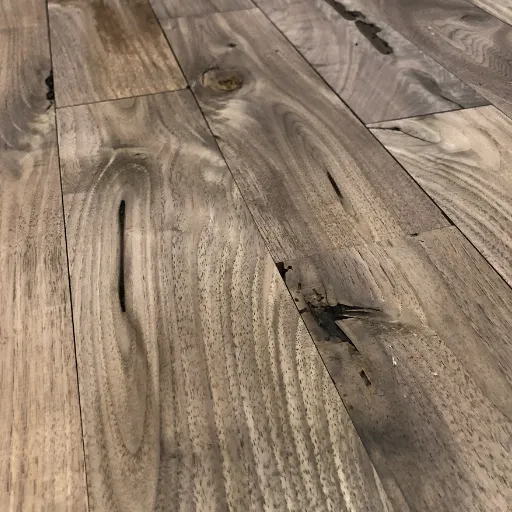
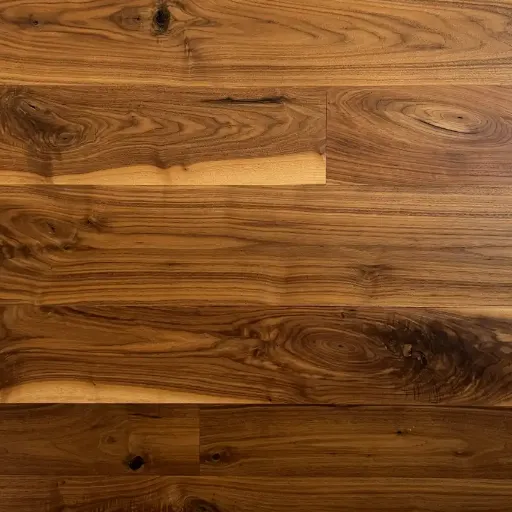
Grade is the most misunderstood cost driver in walnut. It has nothing to do with structural quality. It describes how much pale sapwood the mill allows into the board. Heartwood is the deep chocolate brown most people picture; sapwood is a pale cream.
| Grade | What it looks like | Position in the price range |
|---|---|---|
| Clear / Select | Mostly heartwood, minimal sapwood, uniform deep brown | Top of the material range |
| #1 Common | Some sapwood and color variation, still clean | Middle of the range |
| Character / Natural | Visible sapwood, knots, and strong color shift | Bottom of the range |
Expect 2to2to4 per square foot between the clearest grade and the most character-rich one at the same width and thickness. That’s the easiest place to save money without losing the look you want. Confirm the sapwood allowance in writing, because “walnut” alone says nothing about grade.
Engineered Walnut Flooring Cost by Wear Layer
Engineered walnut is a real walnut veneer bonded to a cross-laminated core. The wear layer is that veneer’s thickness, and it sets both the price and how many times the floor can be sanded.
| Wear layer | Material per sq ft | Refinishing capacity |
|---|---|---|
| 2 mm | 6to6to9 | One careful sand at most |
| 3 to 4 mm | 8to8to12 | One to three refinishes |
| 4 to 6 mm | 11to11to18 | Approaches solid walnut |
| HDF core (any layer) | Varies | Screen and recoat only, no full sand |
That last row matters more than it looks. An HDF core saves money upfront but removes full sanding from the floor’s future.
Which Is Better Value?
Engineered saves money at the thin end, not the thick end. At 2 millimeters it is genuinely the budget route. At 4 to 6 millimeters it costs as much as solid or more, and the reason to choose it is stability over concrete or radiant heat, not price.
For the full stability, lifespan, and cost comparison, see engineered walnut vs solid walnut.
What Drives Walnut Flooring Cost?
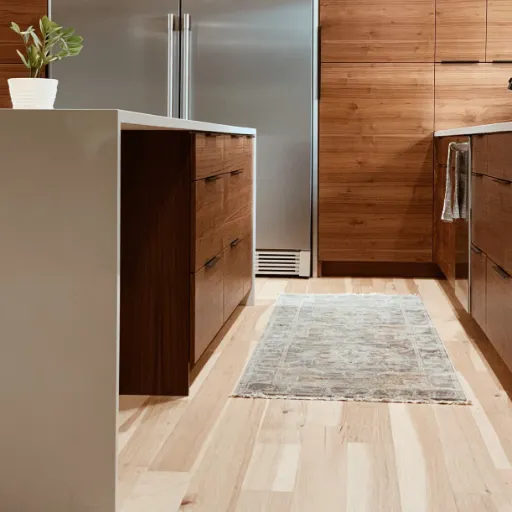
Five variables move a walnut quote. Most published prices name only the first.
Grade and Sapwood Allowance
A mill cuts the same log into different grades depending on how much defect and sapwood it removes. Clear grade means cutting around more of the board, so less of each log becomes sellable flooring. That yield loss is the premium.
Board Width and Plank Length
A wide board has to come from a wide, clean log, and those are the scarcest logs in the pile. Expect a wide-plank floor to run $3 to $7 per square foot more than a standard-width board of the same grade, with longer planks adding more on top. Our guide to wide plank engineered wood flooring explains how engineered construction reaches those widths without the cupping risk solid boards carry.
Steamed vs Unsteamed Walnut
Steaming darkens the pale sapwood and evens out color. It raises yield, so it usually costs less than unsteamed stock. Unsteamed walnut keeps more contrast and figure. Neither is better, but the difference is rarely explained at the point of sale.
Wear Layer, Core, and Veneer Quality
The veneer is the only part of an engineered board you will ever see or touch; everything below keeps that veneer flat. A thicker veneer costs more because it consumes more of a scarce species. We explain how walnut veneer is cut and graded elsewhere.
Finish, Texture, and Region
A factory finish is applied in a controlled environment and cured under UV. A site finish is applied by hand, costs more in labor, and allows a custom tone no factory stock offers. Labor rates vary 10 to 25 percent by market; walnut supply varies more.
Cost to Install Walnut Flooring, by Method
The cost to install walnut flooring runs $3 to $8 per square foot in labor, depending on method and subfloor. The species adds a small premium over oak because walnut marks more easily.
| Method | Labor per sq ft | Notes |
|---|---|---|
| Floating | $3 to $5 | Fastest, works over most subfloors, best for engineered |
| Glue-down | $5 to $8 | Standard over concrete slabs |
| Nail-down | $4 to $7 | Solid and thick engineered, over plywood |
| Site-finishing add-on | $2 to $5 | Only if buying unfinished stock |
For the step-by-step process and acclimation requirements, see our engineered wood flooring installation guide.
The Hidden Costs Most Walnut Guides Leave Out
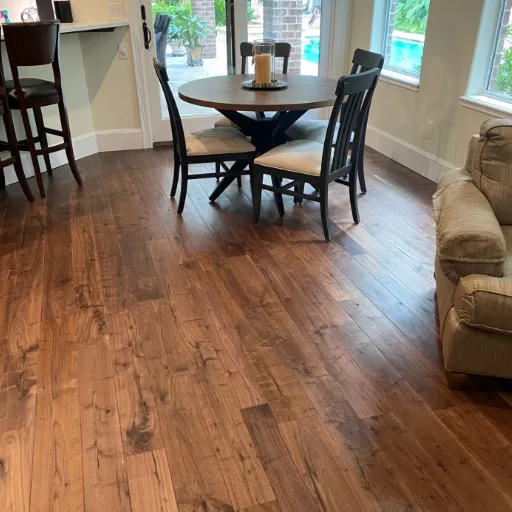
Budget 2to2to5 per square foot above the headline quote on a straightforward job, and more where removal or subfloor work is involved. These line items are almost never in the number you first hear.
- Old floor removal. $1 to $3 per square foot. More if multiple layers come up.
- Subfloor prep and leveling. Varies widely. Older homes often need the most work here.
- Underlayment and moisture barrier. $0.30 to $0.75 per square foot.
- Trim, transitions, and thresholds. $10 to $35 per threshold, plus trim by the linear foot.
- Stair work. $100 to $200 per step.
- Furniture moving and floor protection. Often quoted separately.
- Waste allowance. 10 percent standard, up to 15 percent on complex layouts.
- Delivery, tax, and permits. Freight alone runs $0.75 to $1.25 per square foot.
That list is where a “cheaper” quote stops being cheaper. Two contractors quoting the same rate can differ by thousands once removal, leveling, and trim are priced.
A Real Walnut Flooring Budget: 500 Sq Ft Worked Example
Here is what walnut flooring cost looks like on a real 500 square foot project. These totals include the hidden costs above, which is why the per-square-foot figure runs higher than headline rates.
| Component | Low | Mid | High |
|---|---|---|---|
| Material (500 sq ft) | $3,000 | $5,000 | $9,000 |
| Installation labor | $1,500 | $2,500 | $4,000 |
| Old floor removal | $500 | $750 | $1,500 |
| Subfloor prep | $0 | $400 | $1,200 |
| Underlayment and barrier | $150 | $300 | $375 |
| Trim and transitions | $300 | $600 | $1,000 |
| Waste allowance (10%) | $300 | $500 | $900 |
| Project total | $5,750 | $10,050 | $17,975 |
Mid is a 3 to 4 millimeter engineered board at about $10 per square foot material on a sound subfloor. Low is a 2 millimeter engineered board needing no prep. High is wide plank or clear-grade solid with significant subfloor work. Most of the spread comes from outside the material line, which a buyer watching only the flooring price would miss.
Walnut vs Oak, Maple and Hickory: Cost Comparison
Walnut is the priciest common domestic flooring species, by a wider margin than most buyers expect.
| Species | Janka hardness | Material per sq ft | Installed per sq ft |
|---|---|---|---|
| Red oak | ~1,290 | $3 to $7 | $6 to $12 |
| White oak | ~1,360 | $4 to $10 | $9 to $17 |
| Hard maple | ~1,450 | $5 to $10 | $10 to $16 |
| Hickory | ~1,820 | $4 to $8 | $9 to $15 |
| Black walnut | ~1,010 | $6 to $15 | $10 to $20 |
| Brazilian “walnut” (ipe) | ~3,860 | $4 to $8 | $9 to $14 |
One correction, because it is widely repeated. Black walnut’s Janka hardness is about 1,010, not the 3,680 figure on some cost guides. That higher number belongs to ipe, a different South American species sold as “Brazilian walnut.” Hardness figures here follow the NWFA reference scale.
Against red oak, walnut material runs roughly double at the top of the range, and installed cost about 65 to 70 percent higher. Against white oak the gap is narrower: white oak has risen sharply and now prices close to walnut in many markets, which surprises buyers who assume oak is always the budget choice.
For a full head-to-head on hardness, appearance, stability, and refinishing, see walnut vs oak flooring. For category-wide pricing, our engineered wood flooring cost guide covers every tier.
Why Walnut Costs What It Costs
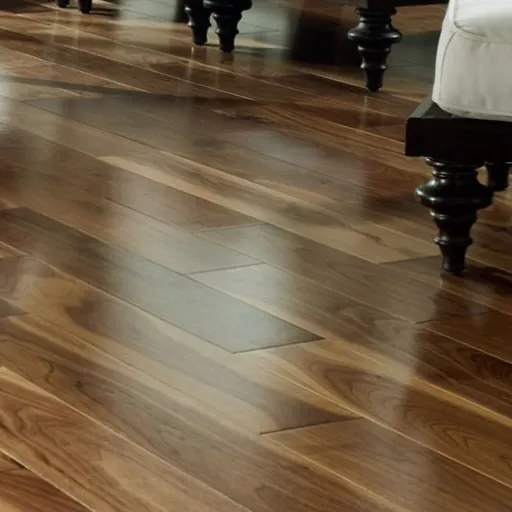
The explanation most price guides skip comes from the lumber market. Walnut is under 5 percent of the U.S. hardwood forest resource, and it commands the highest per-board-foot export price of any widely traded American hardwood, according to American black walnut export data. Scarcity plus export demand sets the floor price before a board reaches a mill.
The arithmetic is straightforward. Rough black walnut runs $6 to $12 per board foot, against $2 to $5 for red oak. At three-quarter-inch thickness, one square foot consumes about 0.75 board feet, so raw wood starts around $4.50 to $9.00 per square foot.
Add defect trimming, drying loss, and machining yield. At a typical 35 percent loss, that raw cost rises to roughly $7 to $14 per square foot finished. That is most of what a solid walnut board sells for before labor, finishing, or retail margin.
The takeaway for buyers: when a walnut quote looks unusually low, it’s rarely a bargain. It’s almost always a thinner wear layer, a higher sapwood allowance, steamed stock, or a narrower plank. Compare specifications, not headlines.
Is Walnut Flooring Worth the Premium?
Upfront price is half the calculation. The other half is what the floor costs over its life.
At about 1,010 Janka, walnut dents more readily than oak, maple, or hickory. Heels, chair legs, and dropped objects leave marks. Those marks darken into a patina many owners like, but busy homes refinish sooner than with oak.
That turns durability into a cost question. Refinishing runs $3 to $6 per square foot, so a 1,500 square foot job lands near $4,500. If walnut needs a recoat every eight to ten years instead of twelve to fifteen, budget the difference.
Walnut earns its premium on design, not toughness. For a bedroom, dining room, or home office the math works. For a floor that shrugs off dogs, boots, and a busy hallway for thirty years, oak or hickory costs less to own.
For the full trade-off analysis, see walnut flooring pros and cons. For refinishing specifics including wear-layer limits, see refinishing engineered hardwood floors.
How to Save on Walnut Flooring Without Regret
Real savings exist in walnut, and none require a worse floor.
- Choose #1 Common or Character grade. The look is often indistinguishable in a finished room, and the saving is $2 to $4 per square foot.
- Stay with standard widths. A 5-inch plank reads almost as generous as an 8-inch one at a fraction of the premium.
- Pick a 3 to 4 millimeter wear layer over 2 millimeter. The small step up preserves refinishing options later.
- Choose floating installation where the subfloor allows. It’s the fastest method and usually the cheapest.
- Buy engineered for slabs and radiant heat. Solid walnut over concrete is a risk you don’t need.
- Get three itemized quotes. Itemized means removal, prep, and trim are priced separately, so you can compare honestly.
- Never cut the moisture barrier. It is the cheapest line item and the most expensive one to skip.
FAQ About Walnut Flooring Cost
How much does walnut flooring cost per square foot?
Walnut flooring costs $6 to $22 per square foot for materials and $9 to $32 installed in 2026. Most residential projects land between $12 and $19 installed.
Is walnut flooring more expensive than oak?
Yes, but it depends which oak. Walnut material runs roughly double red oak at the top of the range and installs about 65 to 70 percent higher. Against white oak the gap is smaller, because white oak now prices near walnut in many markets.
Why is walnut flooring so expensive?
Walnut is under 5 percent of the U.S. hardwood resource and carries the highest per-board-foot export price of any widely traded American hardwood. Rough walnut costs $6 to $12 per board foot versus $2 to $5 for red oak, and a square foot of flooring consumes about 0.75 board feet before yield loss.
Is engineered walnut cheaper than solid walnut?
Only at the thin end. A 2 millimeter engineered board costs meaningfully less than solid. At a 4 to 6 millimeter wear layer, engineered walnut installs at $16 to $25 per square foot, overlapping and sometimes exceeding the solid range of $10 to $20.
How much does walnut flooring cost for 1,000 square feet?
Expect $9,000 to $32,000 installed for 1,000 square feet, with most projects between $12,000 and $19,000. Hidden costs add another $2,000 to $5,000.
How much does it cost to refinish walnut floors?
Refinishing runs $3 to $6 per square foot, or about $4,500 for 1,500 square feet. Walnut’s softness means it may need recoating more often than oak, and engineered boards can only be sanded as often as the wear layer allows.
What is the cheapest way to get the walnut look?
Character-grade engineered walnut with a 3 to 4 millimeter wear layer is the most economical route to a genuine walnut floor. Staining oak is cheaper still, but the grain won’t match walnut’s fine, low-contrast texture.
Conclusion
Walnut flooring cost lands between $9 and $32 per square foot installed in 2026, with most homes paying $12 to $19. The spread is not noise. It reflects real differences in grade, wear layer, width, and steaming, all usually invisible on a quote that says only “walnut.”
The three levers that matter most are grade, wear layer, and width. Moving from Clear to Character grade, and from wide plank to standard widths, can save thousands without changing how the finished floor looks. Don’t trade away the moisture barrier or a wear layer so thin the floor can never be sanded.
Walnut is a design decision before it’s a durability decision. It’s softer than oak and it will dent, but it gives a depth of color no stain replicates convincingly. If that trade-off suits the room, the premium is worth paying.
At VitalWood Global, every walnut floor ships with documented sourcing, FSC and PEFC certification on request, and a spec sheet naming the grade and wear layer.
Request samples and a project quote and we will price your room against real square footage, with the hidden line items included from the start.