
Engineered Hickory vs Solid Hickory: Which Is Better?
Engineered hickory is the safer choice when the floor sits on concrete, over radiant heat, in a basement, or needs planks wider than 5 in. Solid hickory wins on sanding life and on how it feels underfoot, as long as it can be nailed over a wood subfloor in a room with stable humidity. Both are real hickory, and both have the same Janka hardness. What changes is the plank underneath the face.
Hickory is the most dimensionally active of the common North American flooring woods, moving roughly twice as much as red oak. That distinction matters more for engineered hickory vs solid hickory than for most species.
If you’ve already chosen hickory, this is the last decision left. You’re weighing construction, not appearance. Below is the comparison, the numbers behind it, the cost crossover nobody mentions, and a spec-sheet checklist you can send a supplier today.
Key Takeaways
- Both floors are real hickory when the wear layer is real hickory. Janka hardness, 1,820 to 2,140, is identical in both forms.
- Hickory shrinks about 7.0 to 7.2% radially and 10.5 to 11.5% tangentially, against 4.0 and 8.6% for red oak. The cross-ply core is a performance fix, not a premium extra.
- Solid hickory is typically 3 to 5 in. wide. Engineered reaches 8 in. and wider, because the core restrains movement.
- Solid hickory can be sanded 3 to 5 times. Engineered hickory takes 1 to 3, depending on wear layer.
- At 4 to 6 mm wear layers, engineered hickory can cost as much as mid-grade solid. Compare installed cost and wear layer, not the label.
What Is Engineered Hickory Flooring?
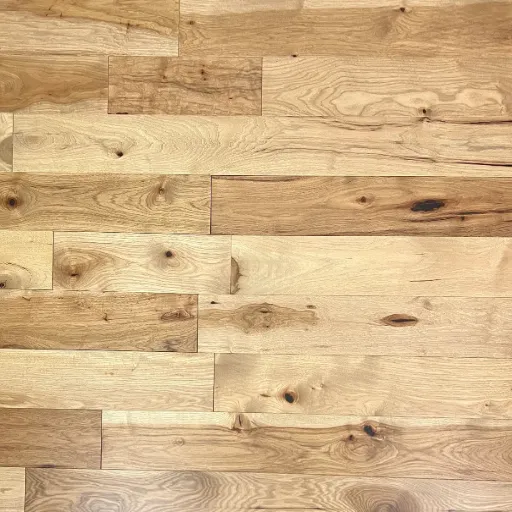
Engineered hickory flooring is a real hickory wear layer, usually 0.6 to 6 mm thick, bonded over a cross-laminated plywood or high-density fiberboard (HDF) core with a balancing backing. The wear layer is the surface you walk on and sand. It is the specification that decides how long the floor lasts.
The cross-lamination is the engineering. Each ply runs at an angle to the one below, so the assembly resists the seasonal swelling and shrinking that a single piece of wood cannot. That is why an engineered plank can be wider, thinner, and more stable than a solid board of the same species.
A word on what engineered isn’t. It isn’t laminate, luxury vinyl, or SPC. Those are printed or composite surfaces that can’t be sanded. A real hickory wear layer over a wood core is real wood flooring, and the National Wood Flooring Association (NWFA) treats it as such.
Our engineered hickory flooring guide covers species, grades, and color variation in more depth. This page stays on the construction decision.
Comparing wear layers on paper is harder than comparing them in the hand. Request a hickory sample and tell us the substrate and the plank width you have in mind.
What Is Solid Hickory Flooring?
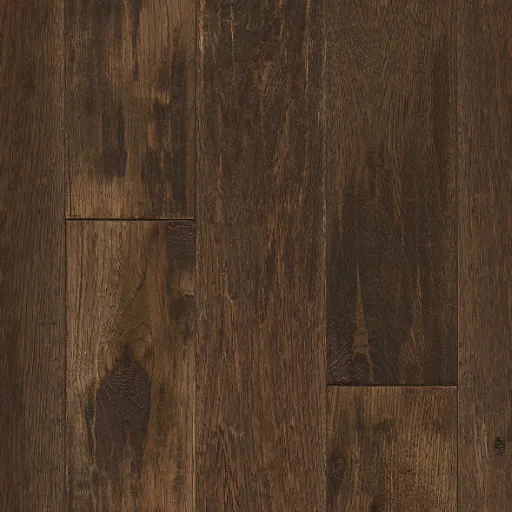
Solid hickory flooring is a single milled board of hickory, usually 3/4 in. (19 mm) thick, with tongue-and-groove edges and roughly 1/4 in. (6.4 mm) of sandable wood above the tongue. It is installed by nailing through the tongue into a wood subfloor, on or above grade.
The board is the same species as the wear layer on an engineered plank. The difference is depth: an engineered plank carries 1 to 6 mm of hickory, while a solid board carries the full 19 mm, and that extra wood is what buys the refinishing life.
Typical widths run 3 to 5 in. Push wider and sourcing narrows while cupping risk rises, because a wide board of a high-movement species takes more humidity swing across its face.
Specification check: solid hickory is a nail-down product over a wood subfloor. If your substrate is a concrete slab, the solid-versus-engineered question is already answered.
Engineered Hickory vs. Solid Hickory: Side by Side
| Factor | Engineered hickory | Solid hickory |
|---|---|---|
| Construction | Hickory wear layer over a cross-ply core | Single 3/4 in. (19 mm) hickory board |
| Wear layer | 0.6 to 6 mm, specified per product | About 6.4 mm above the tongue |
| Typical plank width | Up to 8 in. and wider | 3 to 5 in. |
| Installation | Float, glue-down, or nail-down | Nail-down only |
| Concrete, radiant heat, basement | Yes, with an approved assembly | Usually not suitable |
| Dimensional stability | High | Low to moderate |
| Full refinishes | 1 to 3, by wear layer | 3 to 5 |
| Installed cost (2026) | $8 to $14 per sq ft | $9 to $23 per sq ft |
| Best use | Wide planks, slabs, basements, humid climates | Traditional nail-down over a wood subfloor |
That table is the summary. The rest of this page is the reasoning behind each row, because two of them decide most projects: movement and refinishing.
Why Hickory’s Movement Matters More Than It Does for Oak or Maple
Wood shrinks as it dries and swells as it takes on moisture. The amount a species moves is measurable, and hickory sits at the top of the range among the species most often sold as flooring.
| Species | Radial shrinkage | Tangential shrinkage | Volumetric | Density (lb/ft³) |
|---|---|---|---|---|
| Shagbark hickory | 7.0% | 10.5% | 16.7% | 50 |
| Pignut hickory | 7.2% | 11.5% | 17.9% | 52 |
| Red oak | 4.0% | 8.6% | 13.7% | 43.8 |
| Hard maple | 4.8% | 9.9% | 14.7% | 44.0 |
| Black walnut | 5.5% | 7.8% | 12.8% | 38 |
Source: species records, which follow USDA Forest Service Wood Handbook data.
Read the tangential column, because that is the direction across the width of a plank. Hickory moves about 10.5 to 11.5% across that dimension. Red oak moves 8.6%.
On a 5 in. board, that difference is visible at the joints through a heating season. The hickory vs oak flooring comparison covers what that gap does over a decade of seasons.
Dana, a millwork project manager, learned this on a 2019 renovation. The spec called for 5 in. solid hickory across an open-plan ground floor with a new heat pump. The first winter brought 3 mm gaps at the joints, and the client read them as a defect.
Nothing had failed. The building had simply dried below 35% relative humidity, and hickory responded first. The fix was a humidifier and a set point, not a new floor.
The cheaper lesson would have been to test the width and construction against the building’s humidity range before ordering. A cross-ply core interrupts the movement, so the assembly responds to humidity far more slowly than a solid plank does. On a wide plank over a slab, that is a performance difference, not a marketing one.
Neither construction is waterproof. An engineered core can swell if water sits on an unsealed edge, so the waterproof claim in flooring marketing is worth reading closely. Treat both as wood floors and plan for moisture control either way.
If your project involves a below-grade room, the basement installation guide covers membranes and moisture testing in detail.
Does Engineered Hickory Dent Less? No, and Here’s Why
Engineered hickory does not dent less than solid hickory. The surface is the same wood either way, so the hardness number does not change with construction.
| Species | Janka hardness (lbf) | Character |
|---|---|---|
| Pignut hickory | 2,140 | Bold, varied, very hard |
| Shagbark hickory | 1,880 | Bold grain, cream to brown |
| Pecan, often sold as hickory | 1,820 | Similar look, slightly softer |
| Hard maple | 1,450 | Uniform, creamy, fine grain |
| White oak | 1,350 to 1,360 | Calm, linear, water resistant |
| Red oak | 1,220 | Open grain, warm, plentiful |
| Black walnut | 1,010 | Dark, soft, premium |
The Janka test measures the force needed to embed a steel ball halfway into the wood. It predicts dent resistance against chair legs, dropped tools, and pet claws. It doesn’t predict scratch resistance. Scratches come from grit underfoot, and the coating takes that damage, not the wood.
Two honest caveats. First, a very hard face over a softer core still transfers impact, and a thin veneer has less material to absorb it. Second, a floor this hard is unforgiving underfoot and unkind to dropped dishes. Hardness is a trade, not a free upgrade.
If dent resistance is why you chose hickory, construction won’t change the answer. What you control is the finish and the wear layer. A matte, wire-brushed surface hides marks better than a high-gloss film, and the hickory flooring pros and cons page covers the rest, including color variation.
Plank Width: Where Solid Hickory Stops and Engineered Keeps Going
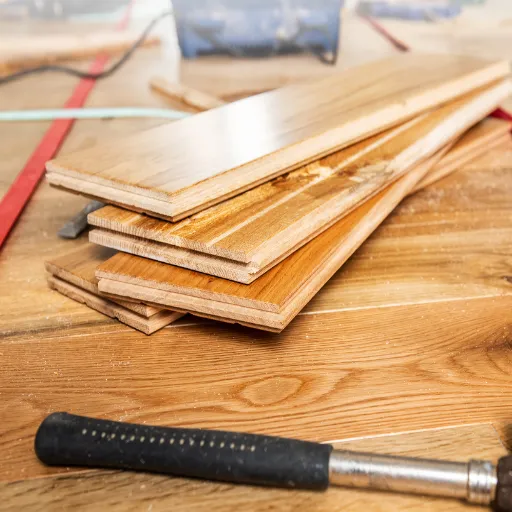
Width is a design decision with a construction consequence. Order the look first, then confirm which form can deliver it.
Solid hickory is typically milled at 3 to 5 in. Above that, sourcing narrows and cupping risk rises. Many installers and dealers no longer warrant wide-plank solid hickory and steer buyers toward engineered instead. That is trade consensus rather than a published statistic, but it is consistent enough to plan around.
Engineered hickory runs to 8 in. and wider, because the core does the restraining. The same species, the same face, a different substrate under it.
For a 7 in. or 8 in. floor, the decision is effectively made for you. For a 4 in. floor over a wood subfloor in a house with a humidifier, solid remains a reasonable, long-lived choice.
Wear Layers and Refinishing: How Many Times Can Hickory Be Sanded?
Hickory flooring wear layer thickness is the number that answers this question. Solid hickory can be sanded 3 to 5 times over its life. Engineered hickory takes 1 to 3, and only if the wear layer is thick enough to give up roughly 2.4 mm (3/32 in.) per pass while leaving a safe margin above the tongue.
| Wear layer | What it supports | Practical refinish count |
|---|---|---|
| 0.6 mm | Entry-level engineered | No sanding; recoat only if the coating is compatible |
| 1 to 2 mm | Standard residential | One light screen-and-recoat, or one careful sand |
| 3 to 4 mm | Premium residential, light commercial | One to two full sands |
| 6 mm and above | High-end residential, commercial | Two to three full sands over decades |
The 2.4 mm figure is the NWFA minimum remaining wear layer above the tongue. Below it, the sanding machinery starts to reach the core and the board is finished.
Hickory adds a wrinkle that oak and maple do not. It is dense, so it dulls abrasives quickly, burnishes under a slow drum, and tears out at the edges. A refinisher who works mostly in oak will quote hickory as if it were oak, then discover the difference on the first pass. Ask for a test board before the full room.
Refinishing technique and timing are covered in the engineered hardwood refinishing guide; refinishing engineered hickory flooring follows the same sequence. The construction point is simpler: the wear layer you buy is the number of times you will ever sand.
Engineered vs. Solid Hickory Cost in 2026
| Form | Material per sq ft | Installed per sq ft | What drives the high end |
|---|---|---|---|
| Engineered hickory | $4.15 to $7.15 | $8 to $14 | 4 to 6 mm wear layer, wide planks, Select grade |
| Solid hickory | $6 to $14 retail | $9 to $23 | Select grade, wide boards, site-applied finish |
Across the category, hickory runs about $4 to $14 per sq ft for material and $8 to $23 installed. The spread is wider than it looks, and it is not all species premium. Grade, width, length mix, core, and finish each move the number.
Buyers who compare solid hickory vs engineered hickory on the label alone miss this. At the thin end, engineered saves money; at 4 to 6 mm wear layers, wide-plank engineered often costs as much as mid-grade solid. The claim that engineered is always 20 to 30% cheaper doesn’t hold for a premium hickory product, so compare installed cost and wear layer together.
Public ranges vary for the same reason: some 2026 buying guides list solid hickory material at $4 to $8 per sq ft because the comparison doesn’t hold grade, width, or finish constant.
Illustrative scenario: two quotes for the same 500 sq ft room can differ by more than $6,000 once grade, wear layer, subfloor preparation, and finish are compared line by line. Marcus, a facilities manager pricing a lobby refloor, found the cheaper quote had specified a 2 mm wear layer where he asked for 4 mm, and had excluded moisture mitigation over the slab. The gap was the specification, not the supplier’s generosity.
Solid hickory flooring cost and engineered cost are both broken out line by line in the hickory flooring cost guide, including the hidden costs that sit outside the material price.
Placement, Radiant Heat, and Basements
Engineered hickory can be floated, glued, or nailed. Solid hickory is nailed, over a wood subfloor, on or above grade.
| Situation | Engineered | Solid |
|---|---|---|
| Wood subfloor, above grade | Yes | Yes |
| Concrete slab, on grade | Yes, with a tested slab | No |
| Basement | Yes, with moisture mitigation | No |
| Radiant heat | Yes, with an approved assembly | Generally no |
| Bathroom, sauna, unconditioned space | No | No |
Radiant heat deserves its own line because it’s where specifications quietly go wrong. Keep the surface at or below 27 °C (80 °F), ramp the temperature no faster than 2 °C per day, and confirm the manufacturer’s warranty covers the assembly you install. Hickory’s movement makes that a real approval question, not a formality.
Either way, target 35 to 55% indoor relative humidity. That’s the band in which wood flooring of any construction behaves predictably.
Feel, Sound, and Finish: What the Table Cannot Show
Four differences never make it into a comparison table, and buyers notice all four.
- Underfoot feel and acoustic performance. A nail-down solid floor sounds solid because it’s fastened to the structure. A floating engineered floor can sound hollow under a heel. Glue-down narrows that gap considerably, which is why many commercial specs still choose it.
- Finish and color control. Site-finished solid allows a custom stain, a seamless surface across a room, and on-site color adjustment. Prefinished engineered arrives finished, installs faster, and carries a factory warranty on the coating. If a specific stain is part of the design, that point alone can outweigh every other row in the table.
- Height and transitions. Solid is 19 mm; engineered runs roughly 9.5 to 16 mm (3/8 to 5/8 in.), and retail hickory SKUs in this market sit at 8.2 mm and 14 mm. That changes thresholds, stair nosings, door undercuts, and the transition to tile. Plan it before the material lands.
- Repair. A solid floor can be sanded again and again. An engineered floor is bounded by its wear layer, but a glued plank can be replaced individually without a full sand, which matters in a busy room with one damaged board.
Sustainability and Material Efficiency
An engineered plank uses far less of the species than a solid board of the same area. A 3 mm wear layer is roughly 16% of the hickory volume in a 19 mm solid board. At 6 mm it’s about 32%, and at 0.6 mm around 3%. Veneer yield from a log is lower than lumber yield, so treat these as directional.
Engineered carries more adhesive and solid carries more wood. Neither is automatically greener. Specify a core and adhesive that meet CARB or EPA TSCA Title VI, ask about FloorScore or GREENGUARD where indoor air quality matters, and judge the lifecycle against the actual product.
Hickory itself isn’t CITES-listed and is Least Concern on the IUCN Red List. The compliance load sits elsewhere: Lacey Act due care and a PPQ 505 declaration on imports into the United States, EU due diligence for European projects, and FSC or PEFC options where a project requires a certified claim. Ask for the certificate scope, not just the certificate name.
How to Choose: Engineered vs. Solid Hickory
Work through these engineered hickory vs solid hickory questions in order. Each one can settle the decision on its own.
- What is the subfloor? Concrete or a basement ends the discussion in favor of engineered.
- Is there radiant heat? Engineered, with an approved assembly.
- How wide do the planks need to be? Above 5 in., engineered.
- What is the humidity range? A building that swings hard favors engineered. A stable, humidified house keeps solid viable.
- How long will you own it, and how many sands does that need? A 30-year horizon with two refinishes needs a 4 mm wear layer or a solid board.
- Is a specific stain or a seamless site finish required? That points to site-finished solid. Otherwise compare installed cost like for like at the same grade and wear layer.
Choose engineered hickory if: the floor is over a slab, in a basement, over radiant heat, wider than 5 in., in a humid climate, in a condo where a floating floor is required, or when you want to stretch a premium species further.
Choose solid hickory if: you have a wood subfloor above grade, stable humidity, a 25-year-plus ownership horizon, and you want the deepest refinishing life, the solid feel, or a site-applied custom finish at 3 to 5 in. widths.
Then put this on the inquiry. These nine lines also test a supplier’s technical depth:
- Wear layer thickness in mm, and total thickness
- Core type: plywood, HDF, or lamellar
- Species group and, where stated, the scientific name
- Grade and permitted sapwood allowance
- Plank widths and the length mix
- Finish system and sheen
- Moisture content at packing
- Warranty terms and exclusions
- Certification documents available for the destination market
If a supplier answers six of the nine and changes the subject, the quote isn’t comparable yet.
FAQ About Engineered vs. Solid Hickory
Is engineered hickory real wood?
Yes, when the wear layer is real hickory. It’s a hickory face bonded to a wood core, not a printed or composite surface. Check the wear layer thickness and the species on the spec sheet rather than the product name.
Is engineered hickory harder than solid hickory?
No. Janka hardness depends on the species at the surface, and both forms use hickory. Shagbark measures about 1,880 and about 2,140 in either construction.
Which lasts longer, engineered or solid hickory?
Solid, in most cases, because it carries about 6.4 mm of sandable wood above the tongue against 1 to 6 mm on an engineered plank. A 3 to 4 mm engineered product with one refinish realistically gives 20 to 30 years, while solid is often quoted at 50 years and up with periodic refinishing.
Can engineered hickory be refinished?
Yes, within limits. Under about 1 mm of wear layer, recoating is the only option. At 3 to 4 mm you can plan one to two full sands. A safe pass leaves roughly 2.4 mm above the tongue.
Is engineered hickory cheaper than solid?
At thin wear layers, yes. At 4 to 6 mm, wide-plank engineered can cost as much as mid-grade solid. Compare installed cost at the same grade and wear layer.
Can solid hickory go over concrete or radiant heat?
Generally no. Solid hickory is nailed over a wood subfloor, on or above grade. Engineered is the product for slabs and radiant systems, with an approved assembly and moisture testing.
How wide can solid hickory be?
Typically 3 to 5 in. Wider boards are harder to source and carry more cupping risk in a species that already moves more than oak. Engineered hickory reaches 8 in. and wider.
Does engineered hickory sound hollow?
A floating engineered floor can, especially on a thin underlayment. Glue-down reduces it, and nail-down over a wood subfloor reduces it further. Ask to hear the assembly you are buying.
Can I mix engineered and solid hickory in one house?
Yes, and it’s common, but match the grade and finish, not just the species. Two hickory floors at different grades will read as two different floors.
Is hickory the same as pecan?
Not exactly. Hickory is a commercial group that includes both true hickories and pecan hickories, so a “hickory” floor may contain pecan. Hardness and appearance overlap, so read the species name on the spec sheet.
Which is better for my climate?
Wide humidity swings favor engineered. A stable, humidified house above grade can carry solid. Either way, hold the interior at 35 to 55% relative humidity.
The Short Version
For engineered hickory vs solid hickory, the core is the performance decision. This species moves about 10.5 to 11.5% tangentially against 8.6% for red oak, so a cross-ply core does more work here than it does in oak or maple. If the floor sits on concrete, over radiant heat, below grade, or wider than 5 in., engineered hickory is the straightforward answer.
Solid hickory still earns its place: 3 to 5 sandings, a solid feel underfoot, and the option of a site-applied finish, provided you can nail it over a wood subfloor and hold the humidity in range.
Neither form is harder than the other, and neither is waterproof. The decision comes down to substrate, climate, width, refinishing horizon, and installed cost at the same wear layer. The engineered vs. solid hardwood comparison covers the same trade-offs without the species specifics.
Before you place an order, put the nine-line specification in front of your supplier. If you are building a specimen list for an engineered hickory floor, send it to VitalWood Global and we will confirm veneer availability, wear layer options, and the documents your destination market needs.